

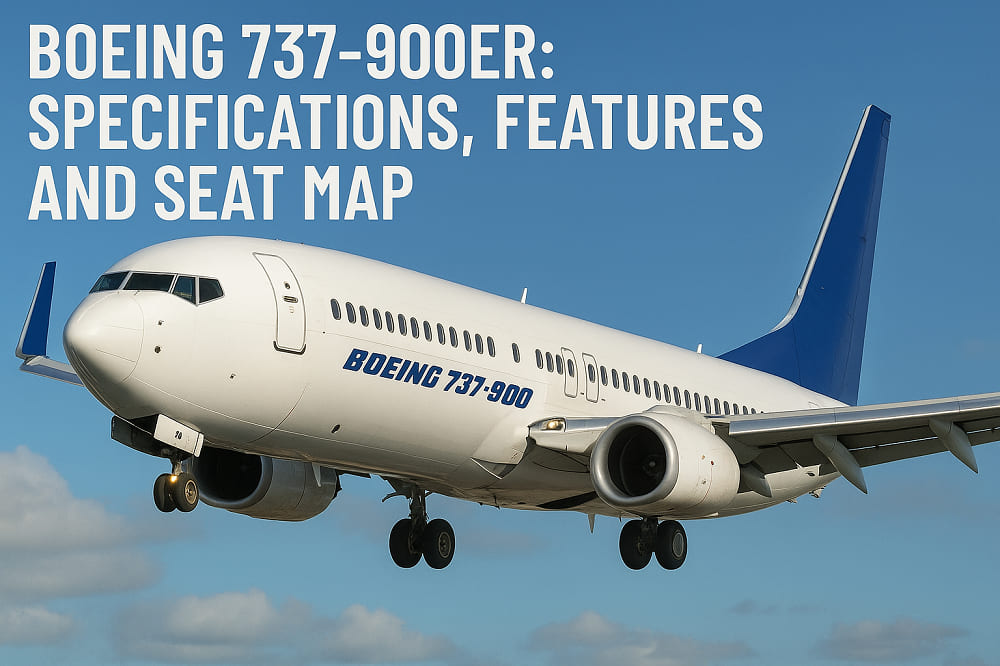
Stretched to 42.11 m (138 ft 2 in), the Boeing 737-900ER is the longest member of the 737 Next Generation family. It seats approx. 180 passengers in a two-class layout and up to 220 in a single class, flies approx. 2,950 nautical miles (5,460 km) with its auxiliary fuel tanks, and is powered by two CFM56-7B turbofans. Boeing delivered 505 of them between 2007 and 2019, most to United, Delta, Alaska Airlines, and Lion Air. Below is an overview of its design, cabin layouts, and operating characteristics.
Overview of the Boeing 737-900ER
The Boeing 737-900ER fills the gap left by the Boeing 757-200’s exit from production. This extended-range variant directly challenges the Airbus A321, offering airlines a versatile solution for their fleet requirements. Its combination of capacity and range has made it a preferred choice for both short and medium-haul operations.
- Seating capacity: approx. 180 passengers (two-class configuration)
- Maximum capacity: 220 passengers (high-density layout)
- Market position: Direct competitor to Airbus A321
- Primary use: Short to medium-haul routes
- Configuration flexibility: Adaptable to various operational needs
Introduction to the Boeing 737-900ER
As the longest variant in the 737 Next Generation series, the Boeing 737-900ER represents a significant evolution in aircraft design. Its enhanced capabilities combine increased passenger capacity with extended range, featuring aerodynamic refinements and structural improvements. The aircraft has demonstrated its versatility by successfully operating routes to diverse destinations including Tel Aviv, Stockholm, and Bucharest.
History and Development
Boeing launched the 737-900ER in July 2005 in response to airline demand for a higher-capacity, longer-range 737-900. Key milestones in the program:
- Official launch: July 2005
- First flight: September 2006
- Initial delivery: April 2007 (to Lion Air)
- Commercial service introduction: 2007
Specifications of the Boeing 737-900ER
Technical Specifications
| Dimension | Measurement |
|---|---|
| Wingspan | 35.80 meters (117 feet 5 inches) |
| Length | 42.11 meters (138 feet 2 inches) |
| Height | approx. 12.5 meters (41 feet 2 inches) |
| Maximum takeoff weight | 85,139 kg (187,700 lb; highest certified option) |
| Range | approx. 2,950 nmi (5,460 km) with auxiliary tanks |
| Engine Type | CFM56-7B turbofan (2x) |
| Engine Thrust | 117-121 kN (26,300-27,300 lbf) each |
Performance and Range
The aircraft cruises at Mach 0.79 (approx. 842 km/h true airspeed) at cruise levels up to its 41,000 ft ceiling. With winglets and the two optional auxiliary fuel tanks that define the ER designation, it covers approx. 2,950 nautical miles (5,460 km) – enough for US transcontinental sectors – while maintaining competitive schedules and operating costs.
CFM56-7B Engines
Boeing never offered an engine choice on the Next Generation family, and the 737-900ER is no exception: every airframe left the factory with a pair of CFM56-7B turbofans, typically at the higher-thrust -7B26 and -7B27 ratings of 26,300-27,300 lbf (117-121 kN). Because the whole family from the -600 to the -900ER runs on the same engine, operators keep a single spares inventory, train mechanics once, and can draw on a large global pool of lease engines.
The same applies on the shop floor: a facility that swaps engines between a 737-800 and a 737-900ER uses identical tooling, and any removed unit is shipped and stored on a CFM56-7B engine stand rated for the engine’s approx. 5,200 lb (2,360 kg) dry weight.
Features of the Boeing 737-900ER
Design and Comfort
The 737-900ER’s design emphasizes both efficiency and passenger comfort, featuring:
- Enhanced aerodynamics for improved fuel efficiency
- Larger overhead bins for increased storage capacity
- Modern LED lighting system for improved cabin ambiance
- Airline-specific seat quirks (examples from Delta’s layout):
- Seat 21D: Partially blocked underseat storage
- Seat 12A: Enhanced room in Comfort+ section
- Seats 15A and 16A: Solid and partial wall features
Technology and Innovations
The Boeing 737-900ER showcases advanced technological features that significantly enhance its operational capabilities. As part of the Next-Generation 737 family, this aircraft incorporates several key innovations:
- Blended winglet technology – reduces fuel consumption by up to 4% compared to earlier models
- Enhanced aerodynamic design for improved efficiency
- Advanced reliability systems for consistent performance
- Optimized fuel management technology
- Environmental sustainability features
Boeing 737-900ER Seat Map and Configuration
The Boeing 737-900ER delivers flexibility in seating arrangements, accommodating various airline business models. Its versatile configuration options include:
| Configuration Type | Passenger Capacity |
|---|---|
| Two-class layout | approx. 180 passengers |
| Single-class layout | Up to 220 passengers |
Seating Layout and Capacity
The aircraft’s interior design maximizes space efficiency while maintaining passenger comfort. Next to the Boeing 737-800, which typically accommodates approx. 160 passengers in two classes, the 737-900ER offers:
- Additional capacity for up to 20 more passengers
- Flexible business class section sizing
- Customizable economy cabin configuration
- Optimized space utilization
Passenger Experience
The Boeing 737-900ER enhances travel comfort through strategic seat placement and innovative cabin design. Notable seating features include:
- Interactive seat selection systems
- Exit row seats with specific storage configurations
- Comfort+ section with enhanced legroom
- Privacy-enhanced seats with solid or partial walls
- Varied window view options
CFM56-7 TR Hold Open Equipment
Airlines Operating the Boeing 737-900ER
Since its 2007 introduction, the Boeing 737-900ER has established itself as a versatile aircraft capable of serving diverse route networks. Its ability to partially replace the Boeing 757-200 while competing with the Airbus A321 has made it particularly attractive to airlines worldwide.
Major Airlines Using the 737-900ER
Several prominent carriers have integrated the 737-900ER into their fleets:
- United Airlines – extensive domestic and international operations
- Delta Air Lines – network efficiency enhancement
- Alaska Airlines – West Coast route network
- Lion Air – launch customer and high-density configuration operator
- Turkish Airlines – extensive European and international routes
Global Reach and Popularity
The Boeing 737-900ER’s worldwide success stems from its operational versatility and efficiency. The aircraft serves diverse markets across multiple continents, demonstrating its adaptability in various operating environments and route structures. Its continued relevance in airline fleets worldwide reflects its successful design and operational capabilities.
Comparison with Other Aircraft
The 737-900ER sits at the top end of the 737NG family by capacity. Boeing positioned it as both a successor to the discontinued 757-200 and a direct competitor to the Airbus A321.
| Performance Aspect | 737-900ER Characteristics |
|---|---|
| Market Position | 757-200 successor, A321 competitor |
| Range Capability | approx. 2,950 nmi (5,460 km) with auxiliary tanks |
| Efficiency | Lower trip cost than the 757s and wide-bodies it replaced on medium-haul routes |
Comparing the 737-900ER with Other Boeing Models
Within the Boeing family, the 737-900ER is best understood against the standard 737-900, of which only 52 were built. The ER carries the same 42.11 m fuselage but adds:
- An extra pair of emergency exits, raising the certified seating limit from 189 to 220
- Two optional auxiliary fuel tanks, stretching range to approx. 2,950 nmi
- A flat aft pressure bulkhead that frees space for extra seat rows
- Strengthened wings and landing gear for the higher takeoff weight
- Improved fuel efficiency compared to the 757-200 it often replaced
Compared with the shorter 737-800, the 737-900ER carries roughly 20 more seats at the cost of slightly higher trip fuel on the same routes.
Advantages and Disadvantages
The Boeing 737-900ER offers several advantages that have contributed to its market success:
- Extended range capabilities for challenging routes
- Strong fuel efficiency through advanced engine technology
- Lower operating costs for airlines
- Simplified crew training due to commonality with other 737 models
- Streamlined maintenance procedures
However, the aircraft does present certain limitations. These include higher noise levels compared to newer models and a narrower fuselage that can feel more confined than alternatives like the Airbus A321, particularly in high-density configurations. Despite these considerations, the 737-900ER maintains its strong market position through its balanced combination of efficiency, capacity, and range capabilities.
FAQ: Boeing 737-900ER
How many passengers does a Boeing 737-900ER carry?
In a typical US two-class layout the 737-900ER seats approx. 178-180 passengers – United configures 179 seats and Delta 180. The certified maximum is 220 in a single class, made possible by an extra pair of exit doors; Lion Air’s high-density aircraft come close to that limit at 215 seats.
What is the difference between the 737-900 and the 737-900ER?
Both share the same 42.11 m airframe, wing, and CFM56-7B engines. The ER adds an extra exit pair (raising maximum seating from 189 to 220), a flat aft pressure bulkhead, structural strengthening, and two optional auxiliary fuel tanks that stretch range to approx. 2,950 nmi. Boeing built only 52 standard 737-900s versus 505 ERs.
Which airlines fly the Boeing 737-900ER?
United Airlines, Delta Air Lines, and Alaska Airlines operate the largest 737-900ER fleets, which is why most seat map searches point to those carriers. Lion Air was the launch customer in 2007, and Turkish Airlines, Oman Air, and El Al also took deliveries. The type remains a mainstay on US domestic trunk routes.
What is the range of a Boeing 737-900ER?
With winglets and its two optional auxiliary fuel tanks, the 737-900ER covers approx. 2,950 nautical miles (5,460 km) – enough for US transcontinental sectors such as New York to Los Angeles. Without the auxiliary tanks, practical range sits closer to the 737-900’s approx. 2,750 nmi. Payload, winds, and reserves shift real-world figures.
Is the Boeing 737-900ER still in production?
No. Boeing delivered the last of 505 737-900ERs in 2019 and replaced the model in its catalog with the 737 MAX 9 and MAX 10. With relatively young fleets, United, Delta, and Alaska Airlines are expected to keep the type flying well into the 2030s.
What engines does the 737-900ER use?
Two CFM56-7B turbofans – typically the -7B26 or -7B27 rating at 26,300-27,300 lbf (117-121 kN) of thrust. The CFM56-7B powers every 737 Next Generation variant, so airlines run one engine pool across their -700, -800, and -900ER fleets, simplifying spares, maintenance planning, and mechanic training.
Read more:
- Boeing 707: History, Features, and Impact on Aviation
- Boeing 777: Features, Specifications, and Insights
- Boeing 737 Max: Latest Updates and Safety Information
- Boeing 737-900: Specifications, Features, and Seat Map
- Boeing 717: Specifications, Features, and Flight Experience
- Boeing 767: Specifications, Features, and Insights
- Boeing 737-700: Features, Specifications, and Seat Map
- Boeing 787-9: Features, Specifications, and Insights
- Boeing 767-400: Specifications, Features, and Seat Maps
- Boeing 777-200: Specifications, Features, and Seat Map
- Boeing 747-400: Features, Specifications, and History
- Boeing 757-300: Specifications, Features, and Seat Map