

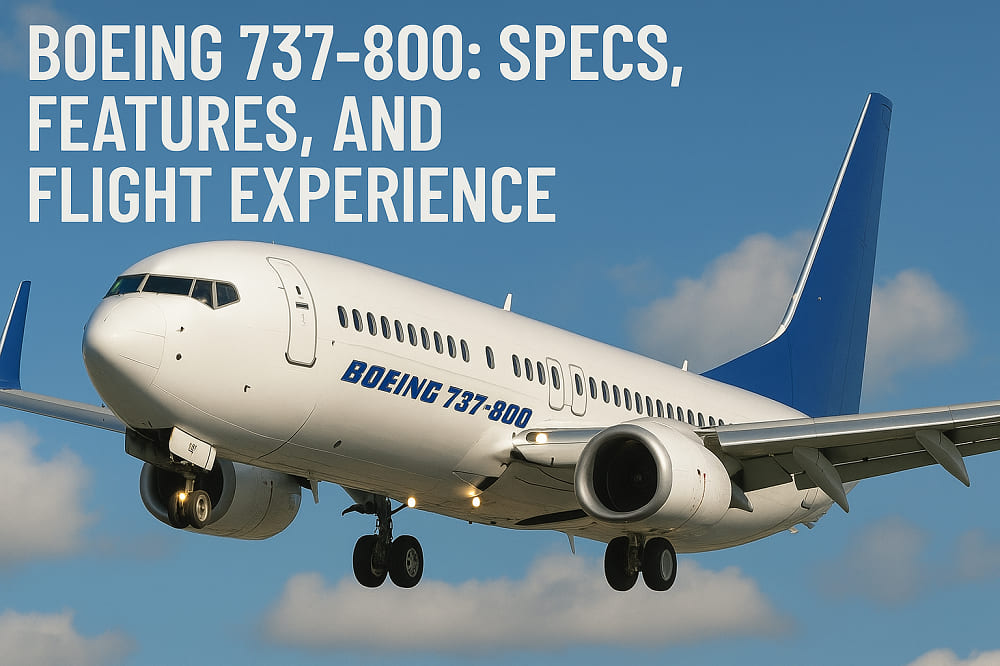
The Boeing 737-800 is a narrow-body, twin-engine airliner from the 737 Next Generation (NG) family, in airline service since 1998. It seats 162 passengers in a typical two-class layout (up to 189 in single class), covers approx. 2,900 nautical miles (5,370 km), and is powered by two CFM56-7B turbofans. With more than 4,000 delivered, it is the most-delivered 737 variant to date. The rest of this article walks through the full specifications, development history, cabin features, and a comparison with the larger 737-900 and 737-900ER.
Overview of the Boeing 737-800
The Boeing 737-800 is a core member of the 737 family and one of the most widely used short- to medium-haul airliners. The narrow-body evolved from its predecessor, the 737-700, to give airlines more seats on the same airframe generation.
As part of the Next Generation (NG) series, the 737-800 exemplifies the perfect balance between operational efficiency and passenger capacity. Its versatility allows airlines to maximize revenue potential while maintaining the reliability that has become synonymous with the 737 family name.
History and Development of the Boeing 737-800
The early 1990s marked the beginning of the 737-800’s development as Boeing sought to enhance its successful 737 Classic series. Launched in September 1994, the aircraft incorporated cutting-edge technology while maintaining compatibility with existing 737 models, ensuring cost-effective pilot training for airlines.
- First rollout – June 1997
- Maiden flight – July 31, 1997
- Commercial service entry – April 1998 with Hapag-Lloyd Flug (now TUIfly)
- Initial target market – Growing low-cost carrier segment
- Design focus – Advanced technology and aerodynamic improvements
Key Milestones in Boeing 737-800 Production
| Year | Achievement |
|---|---|
| 1999 | Became best-selling version of Next Generation 737 family |
| 2006 | Surpassed 737-400 as most commonly used 737 model |
| 2007 | Delivery of 1,000th 737-800 |
| 2012 | Delivery of 5,000th Next Generation 737 (737-800 model) |
| 2021 | Over 4,000 737-800s delivered globally |
Specifications of the Boeing 737-800
The 737-800 combines a 189-seat maximum layout with approx. 2,935 nmi of range, a pairing that suits very different route networks.
Technical Specifications and Dimensions
- Wingspan – 35.8 meters (117 feet 5 inches)
- Length – 39.5 meters (129 feet 6 inches)
- Height – 12.5 meters (41 feet)
- Maximum takeoff weight – 79,016 kg (174,200 lb)
- Operating empty weight – 41,413 kg (91,300 lb)
Engine and Performance Details
- Engines – Two CFM56-7B turbofan engines
- Thrust per engine – 27,300 pounds
- Maximum speed – Mach 0.82 (876 km/h)
- Cruising speed – Mach 0.79 (842 km/h)
- Range – approx. 5,436 km (2,935 nmi) with winglets
- Service ceiling – 41,000 feet
- Takeoff runway requirement – 2,300 meters (7,500 feet)
Seating Capacity and Layout
| Configuration | Capacity | Layout |
|---|---|---|
| Two-class | 162 passengers (12 business + 150 economy) | 2-2 (business), 3-3 (economy) |
| Single-class | Up to 189 passengers | 3-3 throughout |
Engines: What Powers the 737-800
Every 737-800 flies with two CFM56-7B turbofans – the only engine type offered on the 737 Next Generation family. Built by CFM International, a joint venture of GE Aerospace and Safran Aircraft Engines, the CFM56-7B is rated between 19,500 and 27,300 pounds of thrust depending on the version, and its commonality across the -600, -700, -800, and -900 keeps spares, tooling, and training uniform for operators.
With thousands of 737-800s in service, the CFM56-7B is one of the most frequently removed and shipped engines in commercial aviation. Off the wing, each unit – approx. 5,200 lb (2,360 kg) dry – is moved and stored on a dedicated CFM56-7B engine stand, a cradle-and-base fixture built for its mounts and weight. Our guide to aircraft engine stand types explains how these fixtures differ between engine models.
Features of the Boeing 737-800
The Boeing 737-800 pairs the mature 737 airframe with the avionics and aerodynamic updates introduced in the NG series. This Next-Generation (NG) aircraft delivers exceptional performance through its carefully crafted features that enhance efficiency, reliability, and passenger comfort.
- Wingspan – 35.8 meters with winglets for reduced drag (34.3 meters without)
- Length – 39.50 meters optimized for operational efficiency
- Cruise speed – Mach 0.79 (460 knots)
- Service ceiling – 41,000 feet
- Range – approx. 2,935 nautical miles
- Engine type – Two CFM56-7B turbofan engines rated at up to 121 kN (27,300 lbf) each
Cockpit and Avionics
The 737-800’s cockpit exemplifies modern aviation technology with its two-pilot configuration, marking a significant advancement from the three-crew setup of its predecessor, the Boeing 727.
- Six large LCD displays for critical flight information
- Integrated Flight Management System (FMS)
- Advanced autopilot capabilities
- Weather radar system
- Traffic Collision Avoidance System (TCAS)
- Common type rating with other 737 NG variants
Passenger Comfort and Amenities
The Boeing 737-800’s cabin design prioritizes passenger comfort through innovative features and modern amenities. The signature Boeing Sky Interior creates an enhanced travel environment with:
- Sculpted sidewalls for increased spaciousness
- Larger window reveals for better views
- Customizable LED lighting system
- Enhanced overhead bin capacity
- Optional in-flight entertainment systems
- Available Wi-Fi connectivity
- AC power outlets at seats (airline-dependent)
Safety Features and Innovations
Safety stands as a cornerstone of the 737-800’s design, incorporating multiple advanced systems and redundancies:
- Enhanced Ground Proximity Warning System (EGPWS)
- Traffic Alert and Collision Avoidance System (TCAS)
- Damage-tolerant structural design
- Redundant hydraulic systems
- Backup electrical systems
- Continuous safety improvements based on operational feedback
Flight Experience on the Boeing 737-800
The Boeing 737-800 delivers a consistent and reliable flight experience, balancing efficiency with comfort on short to medium-haul routes. Its widespread adoption has made it a familiar sight at airports worldwide, offering passengers a sense of confidence through its proven track record.
Airlines Operating the Boeing 737-800
| Region | Major Operators |
|---|---|
| North America | American Airlines, United Airlines, Delta Air Lines, Southwest Airlines |
| Europe | Ryanair, Norwegian Air Shuttle, Turkish Airlines |
| Asia-Pacific | China Southern Airlines, Qantas |
Passenger Reviews and Feedback
Passenger experiences on the 737-800 vary based on airline configuration and service level. Common feedback includes:
- Positive aspects:
- Quiet cabin environment
- Improved overhead storage
- Reliable performance
- Areas of concern:
- Seat width in economy class
- Limited seat pitch on some carriers
- Compact lavatory size
- Variable entertainment options
Comparing the Boeing 737-800 with Other Aircraft
The Boeing 737-800 competes head-to-head with the Airbus A320, its closest rival in the narrow-body class. Passengers often favor the A320 for its wider cabin, while the two types stay closely matched on performance and range.
| Aspect | Boeing 737-800 | Airbus A320 |
|---|---|---|
| Passenger Comfort | Traditional design, variable comfort based on airline configuration | Generally preferred for comfort, wider cabin feel |
| Performance | Strong operational efficiency, reliable performance | Comparable efficiency, modern flight characteristics |
| Route Flexibility | Excellent balance of capacity and range | Similar capabilities, good network versatility |
While newer aircraft models like the 737 MAX and A320neo offer enhanced fuel efficiency and extended range capabilities, the 737-800 maintains its position as a dependable workhorse in many airline fleets. In practice, comfort depends more on each airline’s configuration and interior choices than on the airframe itself.
Boeing 737-800 vs 737-900 and 737-900ER
The 737-900 and 737-900ER are stretched versions of the same NG airframe: 2.6 meters longer, with the same wing, cockpit, and CFM56-7B engines. The -900ER adds an extra exit pair and optional auxiliary fuel tanks, which raises both its seating limit and its range. Pilots fly all three under a single type rating, and the 737-800 remains the best-selling of the three by a wide margin.
| Feature | 737-800 | 737-900 | 737-900ER |
|---|---|---|---|
| Length | 39.5 m (129 ft 6 in) | 42.1 m (138 ft 2 in) | 42.1 m (138 ft 2 in) |
| Typical two-class seating | 162 | approx. 170-177 | approx. 175-180 |
| Maximum seating | 189 | 189 | 220 |
| Range | approx. 2,935 nmi | approx. 2,750 nmi | approx. 2,950 nmi |
FAQ: Boeing 737-800
How many seats does a Boeing 737-800 have?
A Boeing 737-800 typically seats 162 passengers in a two-class layout (12 business and 150 economy) and up to 189 passengers in a single-class configuration, which is the certified maximum. Actual capacity depends on the airline: Ryanair fits 189 seats, while carriers with a business cabin usually operate 160-172 seats.
What is the range of a Boeing 737-800?
The 737-800 has a range of approx. 2,935 nautical miles (5,436 km) with winglets and a typical passenger load. That covers routes such as New York to Los Angeles or London to the Canary Islands nonstop. Actual range varies with payload, wind, routing, and fuel reserves.
What engines does the Boeing 737-800 use?
Two CFM56-7B turbofans from CFM International, rated between 19,500 and 27,300 pounds of thrust depending on the version. The CFM56-7B is the sole engine option for the entire 737 Next Generation family, which keeps maintenance, spares, and tooling common across the -600, -700, -800, and -900 variants.
What is the difference between the 737-800 and the 737-900ER?
The 737-900ER is a 2.6-meter stretch of the same airframe with an extra exit pair, seating up to 220 passengers versus 189 on the -800. Its range is approx. 2,950 nautical miles thanks to auxiliary fuel tanks. Both share the same wing, cockpit, and CFM56-7B engines, so pilots fly them under one type rating.
How much does a Boeing 737-800 weigh?
The 737-800 has an operating empty weight of approx. 41,400 kg (91,300 lb) and a maximum takeoff weight of 79,016 kg (174,200 lb). Each of its two CFM56-7B engines contributes approx. 2,360 kg (5,200 lb) of dry weight to that total.
How fast does a Boeing 737-800 fly?
The 737-800 cruises at Mach 0.79, approx. 842 km/h (523 mph) at altitude, with a maximum operating speed of Mach 0.82. Typical cruise altitudes run from 35,000 feet up to its certified service ceiling of 41,000 feet, so block times on most routes match those of larger jets.
Read more:
- Boeing 707: History, Features, and Impact on Aviation
- Boeing 777: Features, Specifications, and Insights
- Boeing 737 Max: Latest Updates and Safety Information
- Boeing 737-900: Specifications, Features, and Seat Map
- Boeing 717: Specifications, Features, and Flight Experience
- Boeing 767: Specifications, Features, and Insights
- Boeing 737-700: Features, Specifications, and Seat Map
- Boeing 787-9: Features, Specifications, and Insights
- Boeing 767-400: Specifications, Features, and Seat Maps
- Boeing 777-200: Specifications, Features, and Seat Map
- Boeing 747-400: Features, Specifications, and History
- Boeing 757-300: Specifications, Features, and Seat Map
- Boeing 737-900ER: Specifications, Features, and Seat Map