

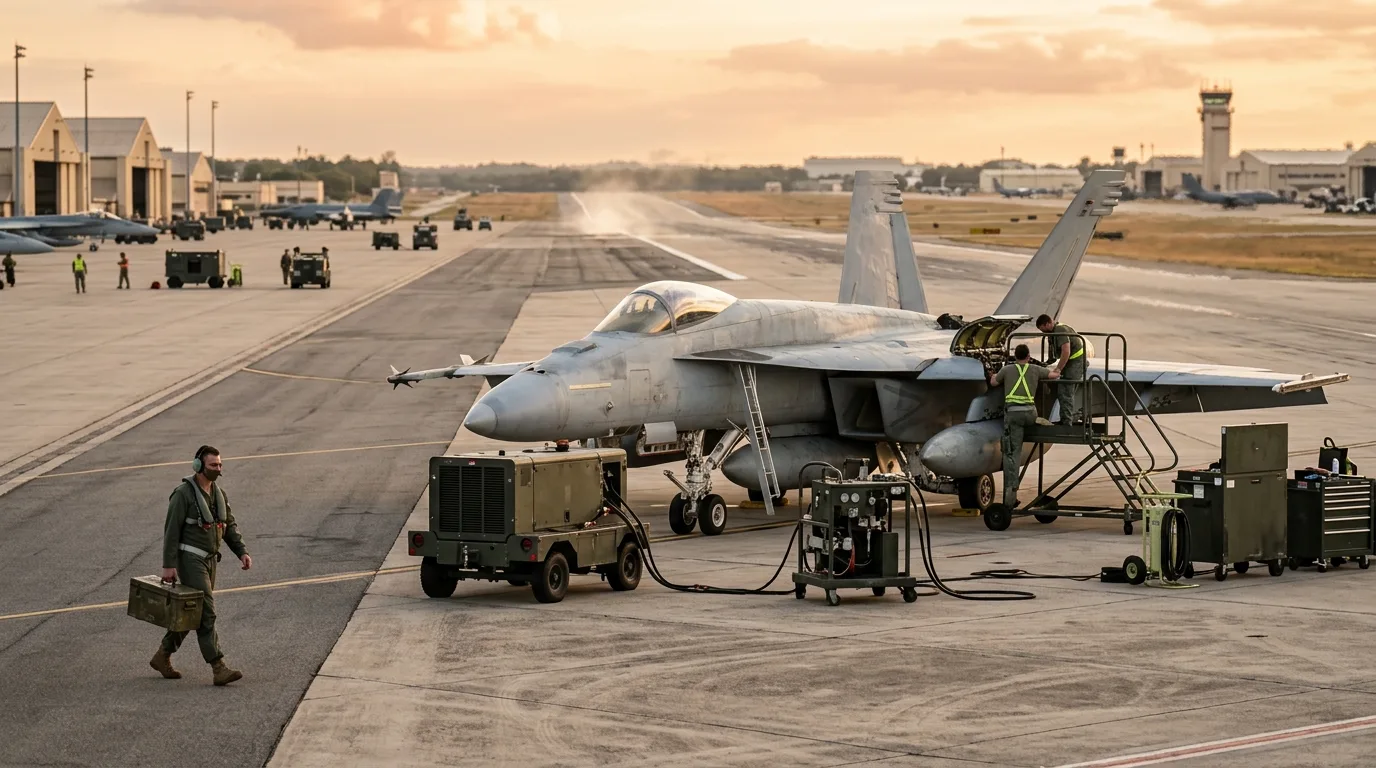
Military aircraft ground support equipment (GSE) covers the tow tractors, ground power units, munitions loaders, maintenance stands and test systems that keep defense aircraft mission-ready between flights. It does the same core jobs as civilian GSE – moving, powering and servicing aircraft – but is engineered for unimproved surfaces, climate extremes and deployment far from fixed infrastructure. Take away the 400 Hz power cart or the bomb lift truck, and a deployed squadron stops flying within days.
Key takeaways
- Military GSE spans six broad categories: towing, power and start, munitions handling, servicing vehicles, access and maintenance stands, and test systems.
- The main difference from civilian GSE is ruggedization: reinforced construction, all-terrain mobility and the ability to deploy by airlift to austere bases.
- Armament loading equipment – bomb lift trucks and linkless ammunition loading systems – has no civilian equivalent.
- Matching ground power correctly (115/200V 400 Hz AC, 28V DC and on some fighters 270V DC) protects avionics during servicing.
- With preventive care, core GSE typically serves 15 to 20 years.
What is military aircraft GSE?
Ground support equipment (GSE) is the machinery that services an aircraft between flights – everything a parked airplane or helicopter needs at a gate, in a hangar or on a remote stand. These systems support the maintenance, servicing and turnaround tasks that keep an aircraft ready for flight; airworthiness itself comes from work performed to approved data, not from the equipment alone. For the civilian baseline – what airlines and EASA Part-145 maintenance organizations use every day – see our full guide to aviation ground support equipment.
In the defense sector, military aircraft ground support equipment underpins every ground-based activity. It keeps fleets mission-ready and lets them launch from virtually any location in the world, from a permanent airbase with fixed hangar infrastructure to a forward operating base with an unimproved surface and no local supply chain.
The scope is wider than on the airline side. Ground crews rely on vehicles, power systems, access platforms and support units to move and maintain aircraft on the tarmac – and, on top of that, defense operations need dedicated machinery to load bombs, missiles, torpedoes and heavy munitions.
Military vs civilian GSE: what actually changes
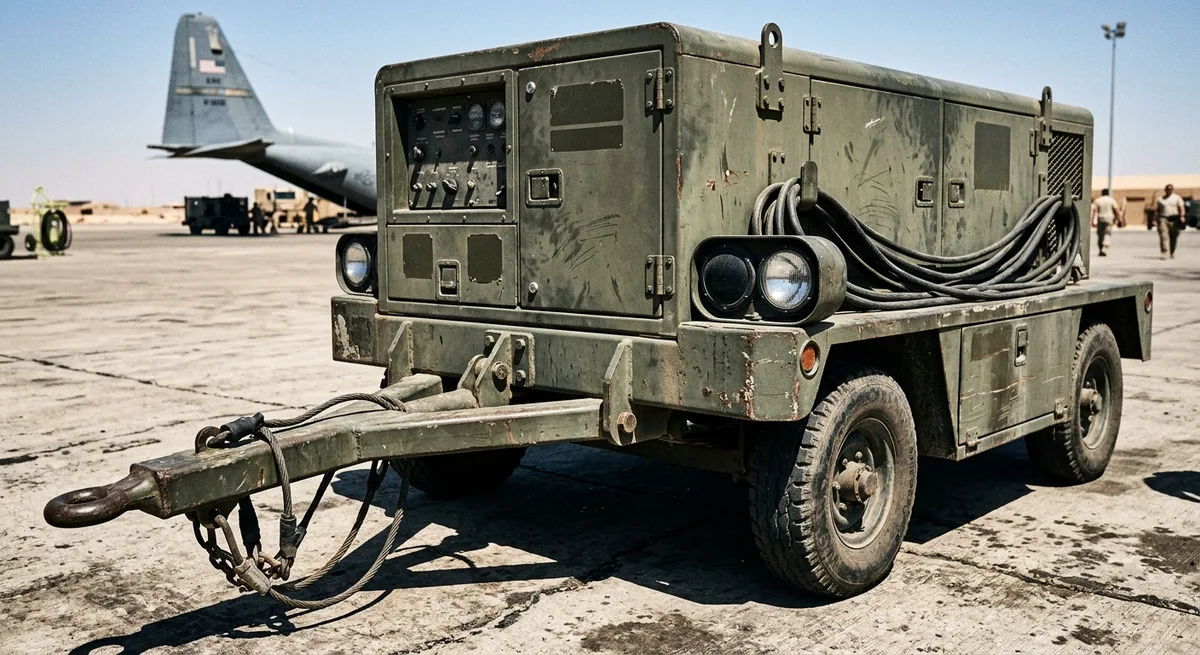
Most equipment categories exist on both sides. What changes is the design envelope. Military GSE is engineered for harsher environments, higher duty cycles and deployability – the ability to be flown or shipped to wherever the aircraft go and work reliably on arrival. Much of it is also built to referenced military standards for environmental resistance (the MIL-STD family, with MIL-STD-810 environmental testing being the most commonly cited example), rather than to the airline-side equipment standards maintained by bodies such as the SAE AGE committee.
| Aspect | Civilian / airline GSE | Military GSE |
|---|---|---|
| Operating surface | Paved ramps and aprons | Paved bases plus unimproved, uneven or temporary surfaces |
| Design references | Airline and airport specs, manufacturer requirements, IATA/ICAO guidance | Military environmental and transportability standards (MIL-STD family) |
| Deployability | Stays at one airport or station | Sized and ruggedized for transport by airlift, sea or road; light units fit tactical airlifters, the heaviest move by strategic airlift |
| Power and cooling demand | Sized to airliner electrical and air conditioning loads – large types draw 90 kVA or more | Matched per airframe: transports and tankers approach airliner loads, fighters draw less but need specific connectors and DC profiles |
| Unique categories | Catering, passenger boarding | Armament loaders, ammunition loading systems, weapons transport trailers |
| Duty profile | Scheduled operations, predictable tempo | Surge operations, continuous sortie generation, extreme climates |
Thicker frames, sealed electronics, all-terrain running gear and heavy-duty drivetrains carry a real cost in weight and price – they are bought so a ground crew can keep servicing aircraft when the ramp is gravel and the forecast is sand.
Main types of military aircraft ground support equipment
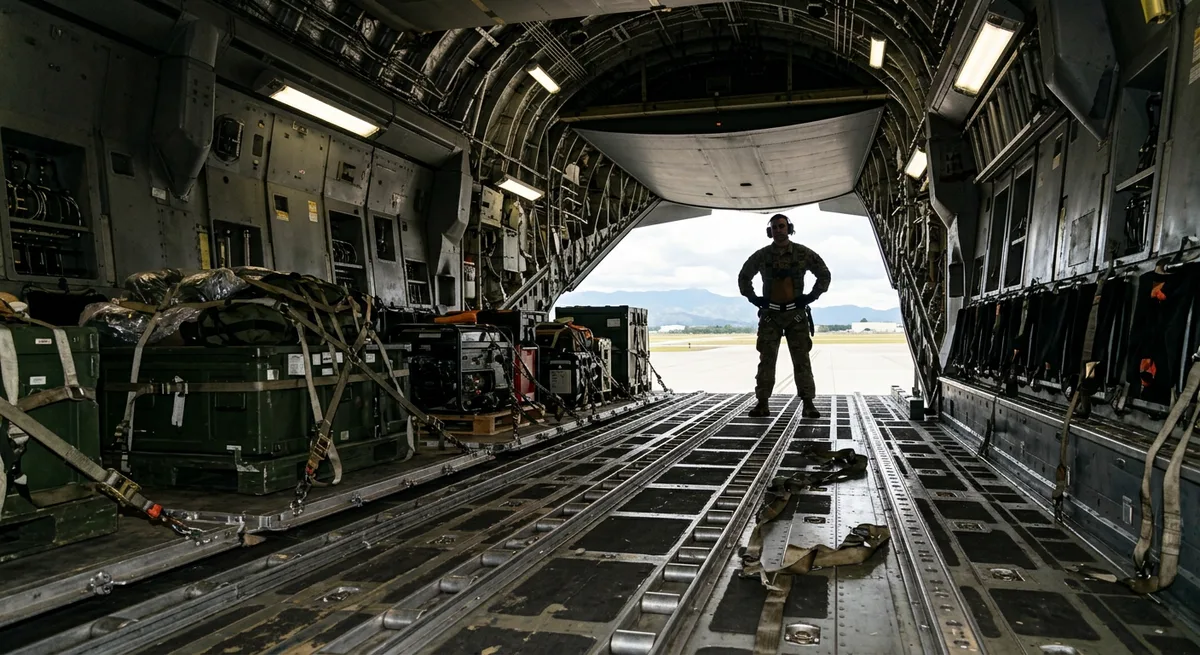
A well-equipped airbase deploys several distinct categories of machinery to cover different roles. The right mix depends on the aircraft types on station, the required towing and power capacity, available space and the operating environment.
| Category | What it does | Typical examples |
|---|---|---|
| Towing and pushback | Moves aircraft on the ramp and into hangars without running engines | Heavy tow tractors, pushback tugs, remotely controlled electric tugs |
| Power and start systems | Supplies electricity and pressurized air with engines shut down | Ground power units (GPUs), air start units |
| Munitions handling | Loads and transports weapons and ammunition | Bomb lift trucks (“jammers”), linkless ammunition loading systems, weapons trailers |
| Servicing and logistics vehicles | Delivers fluids, cargo and personnel to the aircraft | Fuel trucks, water trucks, air conditioning and heating carts, cargo deck loaders, mobile maintenance units |
| Access and maintenance stands | Gives technicians stable, safe access to the airframe and engines | Maintenance platforms, B-stands, engine stands and transport bases |
| Test and diagnostic systems | Verifies aircraft systems on the ground before flight | Hydraulic test stands, cabin pressurization and leakage testers |
Ground power units and voltage needs
Ground power units supply electrical power to aircraft when the main engines are shut down. External power lets crews run onboard systems, complete pre-flight diagnostics and hold aircraft at readiness without draining internal batteries. Because defense fleets operate many different airframes, matching the correct power profile to each aircraft’s electrical architecture is a routine but safety-critical task.
| Power profile | Typical users | Notes |
|---|---|---|
| 115/200V AC, 400 Hz, three-phase | Standard AC bus on transports, tankers, fighters and most fixed-wing types | Output sized to the airframe – from tens of kVA for a fighter to 90 kVA or more for a large transport; fixed solid-state units are common in hangars |
| 28V DC | Carried alongside the AC bus on most airframes; primary power on many helicopters | Servicing and system checks often need both AC and DC connections, not one instead of the other |
| 270V DC | Some fifth-generation fighters | Supplied by dedicated or multi-output ground power units |
| Battery-powered GPUs | Growing across fleet types | Deliver the same power profiles with low noise and no flight line exhaust |
Feeding the wrong profile into an airframe can damage avionics and mission systems worth more than the entire GPU fleet, so flight lines document the required power profile per aircraft type and verify it before every hookup.
Munitions loaders and ammunition systems
Ground crews cannot manually lift large weapons, so mechanized loaders are a fixture of daily flight line work. Armorers use bomb lift trucks – known on the flight line as “jammers” – to hoist bombs, external fuel tanks and large pods, then align them precisely with wing pylons or internal bay attachment points.
On aircraft with internal rotary cannons and linkless gun systems, armorers use dedicated ammunition loading equipment to transfer rounds into the onboard drum; depending on the installation, the same equipment also downloads spent cases and unfired rounds. Mechanizing the transfer speeds up arming considerably and keeps personnel clear of explosive hazards. At the logistics scale, high-capacity cargo deck loaders raise palletized munitions and supplies straight into transport aircraft, and how smoothly that chain runs directly affects how fast a squadron can arm and launch.
Access platforms and engine stands
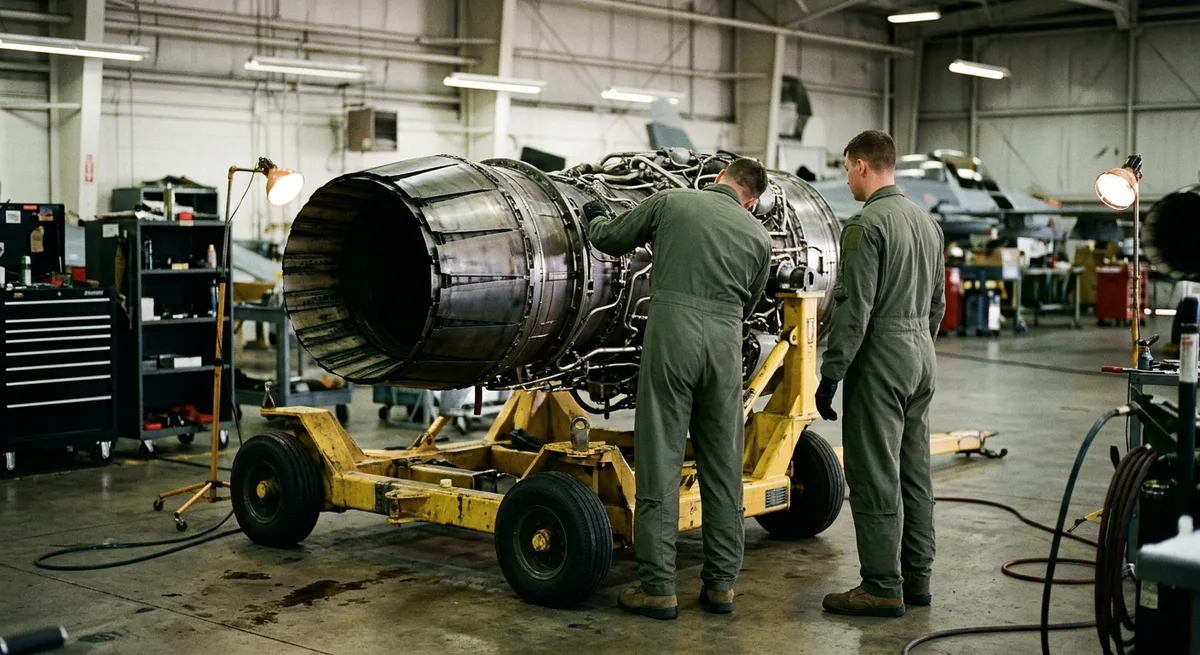
Maintenance stands and raised access platforms complete the standard flight line setup. They give technicians a stable workspace for inspections and repairs on tall airframes – upper fuselage, tail surfaces, engine pylons – where ladders would be slow and unsafe. Engine changes add one more requirement: a transport-rated engine stand that holds the removed engine safely on the ground and on the road. For tankers, transports and patrol aircraft powered by civil-derived turbofans – a P-8’s CFM56 or a KC-135R’s F108 is an airline engine under a military designation – that part of the toolset overlaps directly with the airline world. Combat engines such as the F100 or F135 have different mounts and dimensions and ride on their own dedicated stands. The moves themselves – by road, air or sea – follow the practices described in our aircraft engine transportation guide.
Need an aircraft engine stand? National Aero Stands rents and leases transport-rated stands for CFM56, LEAP, GE90, Trent and PW engine families – browse available engine stands.
Hydraulic and pressurization test systems
Fluid and air systems are checked on the ground during maintenance and troubleshooting, without starting the engines. Where the aircraft design and maintenance procedures allow, hydraulic test stands supply pressurized fluid so technicians can actuate landing gear, flight control surfaces and weapon bay doors, monitoring return flow to catch internal bypasses or external leaks before they compromise handling.
On pressurized aircraft, cabin pressurization and leakage testers do the equivalent job for the pressure vessel: they force air into the fuselage and measure the pressure decay rate to pinpoint degraded door seals or valve malfunctions. Electric motor driven units of this class are sized to pressurize even a large transport aircraft quickly. A seal found leaking at the stand costs a part and a technician’s hour; the same fault at altitude costs an aborted mission and an unscheduled repair.
Maintenance and service life of military GSE
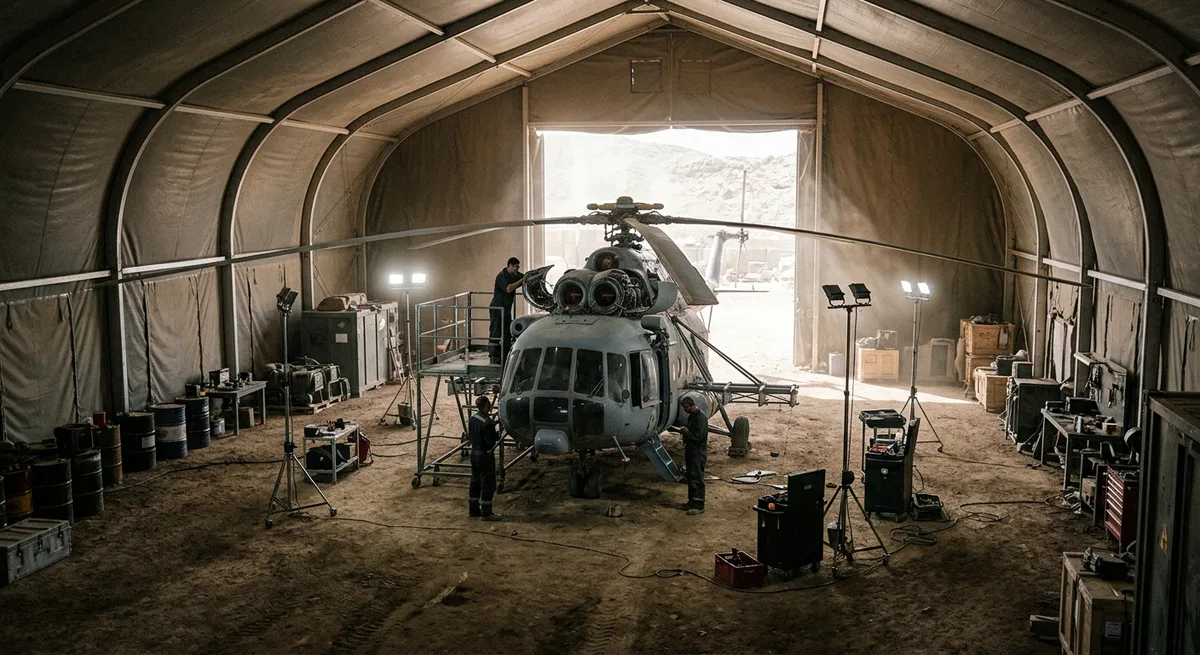
An unserviceable power cart can hold a jet on the ground as surely as a missing spare part, so the GSE fleet gets its own maintenance program. With proper preventive care, a service life of approx. 15 to 20 years from core machinery is a common planning figure in defense GSE lifecycle guidance. Reaching that lifespan takes routine physical inspection plus condition monitoring: modern support units carry sensors and telematics that track performance metrics, fuel consumption, battery health and active faults in real time, so crews can fix minor issues before they become breakdowns that ground aircraft.
On the hardware side, manufacturers increasingly build modular designs into ground units so field crews can swap faulty components quickly, and MRO providers extend equipment life well beyond the initial warranty period through scheduled overhaul. The same discipline applies to spare engines held in reserve – correct aircraft engine storage keeps a war-reserve powerplant ready for installation instead of quietly corroding.
Current trends: electric and autonomous GSE
Electrification is the change furthest along: electric and hybrid GSE removes exhaust from the area around sensitive turbine intakes, cuts noise for ground crews and reduces fuel logistics on base. Current lithium-ion packs let many equipment types cover a substantial part of a shift, depending on duty cycle and charging support – the heaviest units still test that limit.
Autonomy is the second shift: tow tractors and cargo loaders fitted with spatial sensors can follow programmed paths across a crowded ramp without a driver, which frees skilled personnel for technical work and reduces the risk of vehicle-to-aircraft collisions – one of the most expensive and most avoidable categories of ground damage.
Choosing and sourcing military GSE
Procurement teams weigh a short list of parameters before fielding new units:
- Capacity and specifications – power output and towing capability must match aircraft weight and electrical demand to avoid component damage.
- Operating environment – all-terrain capability and climate tolerance decide whether a unit works at a forward operating base or only at home station.
- Commonality – equipment that serves multiple airframes saves enormous logistical effort; sourcing a unique tool for every aircraft type multiplies the supply chain.
- Footprint – crowded flight lines and confined storage dictate maximum physical dimensions.
The new-vs-used question follows the same logic as elsewhere in aviation. Factory-fresh orders carry long lead times; the used aircraft ground support equipment market can deliver quickly during surge demand, provided each asset passes a thorough technical inspection covering original specifications, current wear and service history. Balancing new orders with well-maintained secondary-market units – and mixing standardized platforms with the few customized ones a fleet genuinely needs – is what builds a cost-effective ground network for any airbase.
Whichever route a force takes, the buying criteria stay the ones above: capacity matched to the airframes on station, tolerance for the operating environment, commonality across types and a footprint the ramp can absorb. Get those four right and the ground fleet stops being the limiting factor in sortie generation.
FAQ: military aircraft ground support equipment
What counts as ground support equipment in military aviation?
Ground support equipment (GSE) is the collective term for machinery used to service aircraft on the ground between flights: tow tractors, ground power units, air start units, loaders, maintenance stands and test systems. It covers everything an aircraft needs while parked – power, movement, access, servicing and diagnostics – without running its own engines.
What are the main types of military ground support equipment?
The main GSE types fall into six groups: towing and pushback vehicles, power and start systems, servicing and logistics vehicles, access and maintenance stands, test and diagnostic systems, and – in military aviation only – munitions handling equipment such as bomb lift trucks and ammunition loading systems.
How is military GSE different from civilian GSE?
Military GSE is ruggedized: reinforced frames, all-terrain mobility, higher power output and construction referenced to military environmental standards rather than airline specs. It is also designed for deployability – transport by airlift to austere bases – and includes armament loading categories that have no civilian counterpart.
What is a “jammer” in military aviation?
A jammer is the flight line nickname for a bomb lift truck – a compact hydraulic vehicle armorers use to hoist bombs, missiles, fuel tanks and pods, then align them precisely with an aircraft’s wing pylons or internal bay attachment points. It replaces manual lifting for loads far too heavy and hazardous for crews to handle.
Why do military aircraft need 400 Hz ground power?
400 Hz is not a military peculiarity – airliners use it too, because the higher frequency keeps onboard generators and motors small and light. The standard interface is 115/200V three-phase AC at 400 Hz, and ground power must match that profile to run avionics safely with engines off. Most airframes also carry a 28V DC bus, helicopters are often DC-primary, and some fifth-generation fighters add 270V DC – which is why bases operate several GPU profiles.
How long does ground support equipment last?
With routine inspection and preventive maintenance, core ground support equipment typically serves approx. 15 to 20 years. Condition monitoring via sensors and telematics, modular component design and periodic MRO overhauls are the main factors that push equipment toward the upper end of that range.