Ground operation

Ground operation
Jet engine transportation relies on three main methods: road haulage on an air-ride trailer, air freight aboard a cargo aircraft, and sea freight for long moves that are not time-critical. Size, distance and deadline decide between them – a narrow-body engine of approx. 2.3-3.1 t travels well by truck, while a wide-body engine of approx. 4.5-8.5 t may need a 747 freighter, a ship or, at the largest fan diameters, an AN-124. In every case, the engine rides on a manufacturer-approved transport stand that isolates it from shock and vibration.
Key takeaways
A jet engine weighs as much as a small truck, but it tolerates none of a truck’s handling. One hard jolt can damage fan blades, bearings or the accessory gearbox, and the manufacturer’s shock limits apply from the moment the engine leaves the pylon. Replacement values for commercial engines run into the millions of dollars, and into the tens of millions for the largest wide-body types, so a transport error is never a minor claim.
Time pressure makes it harder. When an aircraft is grounded (AOG), lost revenue and rebooking costs accumulate by the hour – for a wide-body operation, industry estimates run to tens of thousands of dollars per hour. That is why a replacement engine often has to move from an MRO shop to a stranded aircraft on another continent within days, not weeks, and why safe aircraft engine transportation is a logistics discipline of its own rather than ordinary heavy freight.
Planning starts from two numbers, engine weight and fan diameter, because together they set the trailer, the crane capacity and the freighter door the move has to clear. The table below shows the most common engine families – bare engine weight, before adding a transport stand that can weigh another 1-3 t.
| Engine | Typical aircraft | Approx. dry weight | Approx. fan diameter |
|---|---|---|---|
| CFM56-7B | Boeing 737NG | approx. 2.4 t | approx. 1.55 m |
| LEAP-1A | Airbus A320neo | approx. 3.0 t | approx. 1.98 m |
| Trent 700 | Airbus A330 | approx. 4.8 t | approx. 2.47 m |
| Trent 800 | Boeing 777 (early) | approx. 5.9-6.1 t | approx. 2.79 m |
| GE90-115B | Boeing 777-300ER | approx. 8.3 t | approx. 3.25 m |
One mode is missing from the list of options on purpose: rail. Coupling impacts and track-induced vibration can exceed the shock limits engine manufacturers set for their products, so the industry keeps engines on air-suspended trucks, freighters and ships.
Real shipments are rarely single-mode: even a 747F charter begins and ends with a truck leg, and a sea move adds port handling on both sides. The table compares the three methods on time, cost and their main constraint.
| Method | Best for | Typical transit time | Relative cost | Main constraint |
|---|---|---|---|---|
| Road (air-ride trailer) | domestic and regional moves, airport and port legs | 1-5 days | baseline | oversize permits for wide-body engines |
| Air freighter | AOG response, intercontinental urgency | 1-3 days door to door | highest – a multiple of road | door dimensions, freighter availability |
| Sea freight | planned, non-urgent intercontinental moves | 3-8 weeks | low to moderate | transit time, humidity, preservation effort |
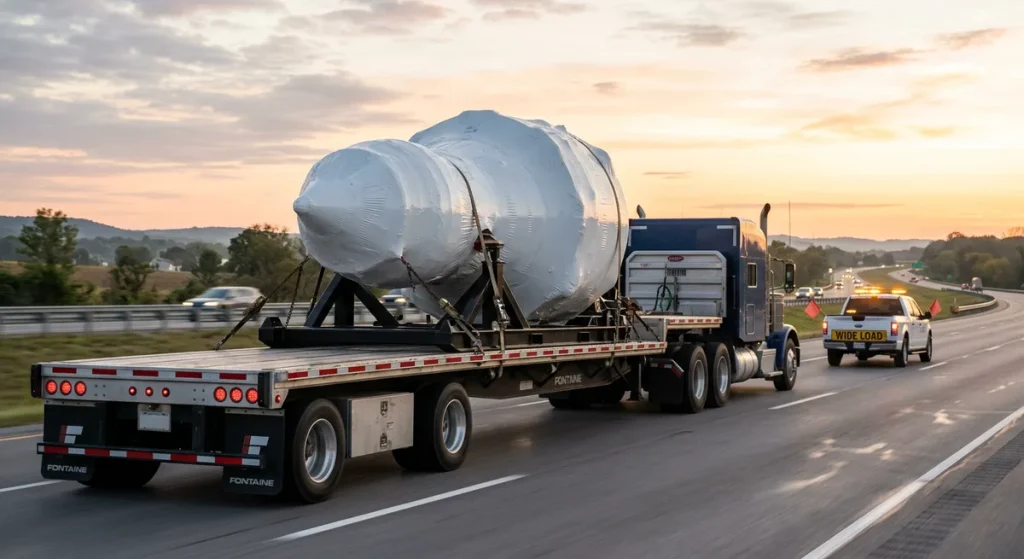
For domestic and regional distances, a dedicated truck with an air-ride trailer is the standard answer. Air suspension replaces steel springs with pressurized air bags, smoothing out road shock before it reaches the cargo. The transport stand is secured to the trailer deck at multiple points, and a fitted transport cover protects the inlet and exhaust from weather and debris.
A CFM56-7B, with its 1.55 m fan, usually stays within normal trailer dimensions and needs no special permits. A LEAP-1A at approx. 1.98 m is a borderline case: once it sits on a stand, the loaded width can cross oversize thresholds in some jurisdictions. Wide-body engines cross them almost by definition – with fan diameters of 2.5-3.25 m, a Trent or GE90 becomes an oversize load, which brings route surveys, escort vehicles and permit lead times into the plan.
The single most useful road routine is the tie-down check after the first kilometers: shock mounts settle under load, and straps that were tight at the dock work loose. Drivers briefed on high-value aerospace cargo repeat that check at every stop and slow down over rough sections. Loading itself is done by crane or heavy forklift, lifting the engine together with its stand – never by slinging the bare engine outside approved lifting points.
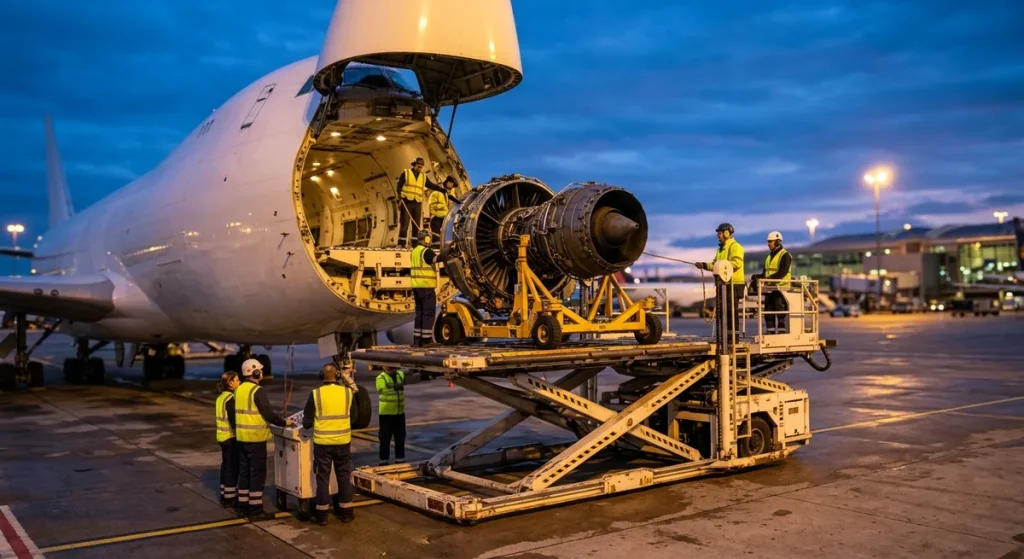
When an AOG clock is running or an ocean is in the way, engines fly. Narrow-body engines travel on main-deck positions of standard freighters. Wide-body engines almost always need a dedicated freighter – typically a 747F loaded through the side cargo door, or an AN-124 from Antonov for the largest packages.
The limit is usually the package envelope, not the mass. Boeing rates the 747-8 Freighter for well over 100 t of payload, so no engine’s weight troubles the airframe; the question is whether the engine on its stand passes through the side door. That is why the largest types – the GE90-115B that powers the 777-300ER, or the big Rolls-Royce engines like the one covered in our Trent 800 overview – need extra planning.
| Engine | Approx. fan diameter | Standard 747F loading | Common air freight solution |
|---|---|---|---|
| CFM56-7B | approx. 1.55 m | fits | main deck of a standard freighter |
| LEAP-1A | approx. 1.98 m | fits | main deck of a standard freighter |
| Trent 700 | approx. 2.47 m | fits with planning | 747F side cargo door |
| GE90-115B | approx. 3.25 m | generally does not fit | AN-124, or surface transport; fan case may be removed and shipped separately |
Per kilometer, nothing costs more than dedicated air freight. Against a wide-body AOG bill it still tends to win, although not every grounded aircraft justifies a charter – a narrow-body engine often rides a scheduled freighter on a next-flight-out booking at a fraction of charter cost.
For planned moves with no deadline – engines heading to long-term parking, cores returning after a sale, or spare engines positioned in advance – sea freight costs a fraction of a charter flight. Most engines on transport stands are too wide or too tall for a standard closed container, whose internal width is approx. 2.35 m, so they travel as breakbulk, on flat racks or in open-top containers; only some narrow-body engines on low-profile stands fit inside a standard box.
The price of the low rate is time and environment. Door-to-door times of several weeks are normal, and marine air is humid and salty, so the engine must be sealed, bagged and protected with desiccant before the voyage. The preservation requirements overlap heavily with those for aircraft engine storage, and an engine arriving after a long voyage should be treated much like one coming out of storage: inspect it, read the humidity indicators, re-preserve if needed.

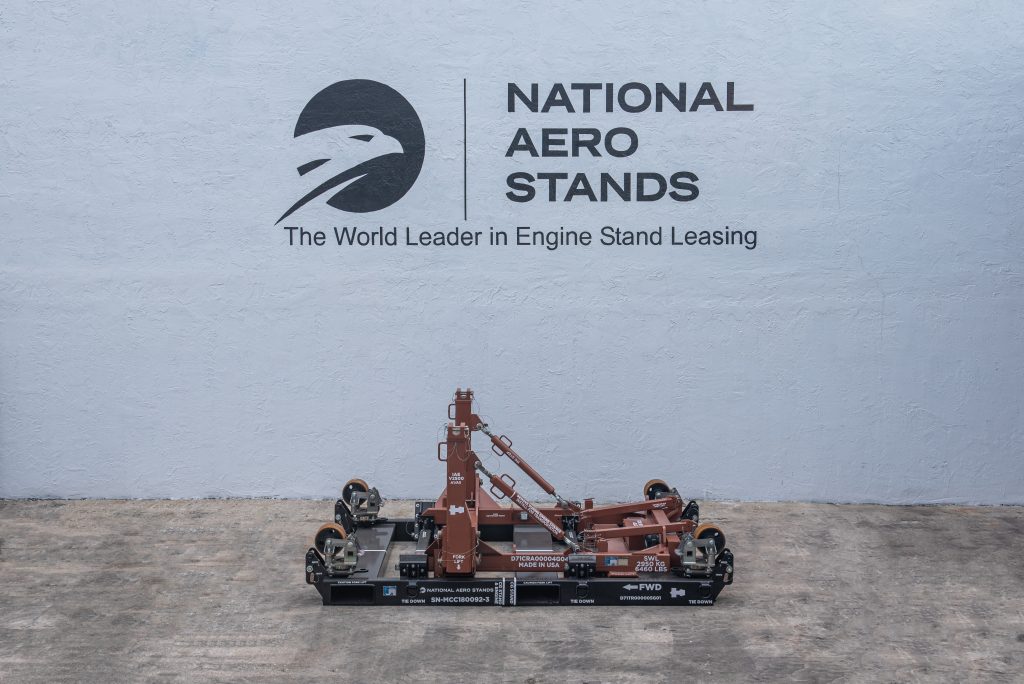
After removal from the pylon the engine is lowered into a transport stand – a two-part assembly made of an engine-specific cradle and a wheeled or skid-mounted base frame. The cradle supports the engine at interface points the OEM defines for that stand and engine model, usually based on the engine’s approved handling and mount locations, so transit loads pass through structure designed to carry them rather than through the casings. Aircraft engine transportation stands are the single most model-specific piece of equipment in the whole chain – our guide to aircraft engine stand types covers how transport cradles differ from storage and maintenance configurations.
Between cradle and base sit shock mounts – elastomer isolators that absorb vibration and impact energy before it reaches the engine. This is what separates a transport-rated stand from a simple shop fixture: the first is designed for the road, the second is not, and confusing the two is one of the most expensive mistakes in engine logistics.
Engine manufacturers define which stands are approved for their products, including permitted transport modes, tie-down schemes and shock limits. Using a non-approved stand can void warranty coverage and can distort an engine case in ways that only show up at the next shop visit. A wide-body engine needs a stand built for its mass and geometry – see the Trent 700 engine stand for a shock-mounted transport configuration for the A330 fleet, or the GE90 engine stand at the top end of the scale. When no approved stand is on site, renting is standard practice: National Aero Stands offers aircraft engine stands for rent and lease across the major engine families.
Need a CFM56-7B engine stand? National Aero Stands rents and leases shock-mounted, OEM-compliant CFM56-7B engine stands ready for road and air transport – available on AOG timelines.
Three constraints filter the options quickly. A fan diameter above approx. 3 m rules out most freighter side doors. An ocean rules out road alone. An AOG deadline rules out the sea. Whatever passes all three filters is then a question of budget – planned moves open the cheaper road and sea routes, urgency forces air.
Road sets the cost baseline in jet engine transportation. Sea freight can undercut it on long routes, at the price of tying the asset up for weeks; a dedicated freighter costs a multiple of either. Cranes at both ends, permits, insurance and stand logistics add to every option, so price the move door to door, not leg by leg.
Choosing the method settles less than it seems. The engine still has to be preserved, mounted, cleared through customs and monitored in transit, and a missing purge certificate stops a charter as surely as a missing crane. We cover that side step by step in our guide to the aircraft engine shipping process.
Narrow-body engines weigh approx. 2.3-3.1 t: a CFM56-7B is approx. 2.4 t and a LEAP-1A approx. 3.0 t. Wide-body engines run approx. 4.5-8.5 t: a Trent 700 is approx. 4.8 t dry and the GE90-115B tops the scale at approx. 8.3 t. Add roughly 1-3 t for the transport stand when planning cranes and trailers.
Rail is generally avoided for commercial jet engines: coupling impacts and track vibration can exceed OEM shock limits even on a shock-mounted stand, and approvals and handling interfaces for rail barely exist in engine logistics. The standard surface solution is a dedicated truck with an air-ride trailer, which keeps recorded shock loads far lower and allows door-to-door delivery.
An air-ride trailer replaces steel-spring suspension with pressurized air bags that absorb road shock and vibration. Combined with the shock mounts built into the transport stand, it keeps impact loads on the engine within manufacturer limits. It is the default equipment for road moves of commercial aircraft engines.
Because of diameter, not weight. GE Aerospace quotes a fan diameter of approx. 3.25 m for the GE90-115B, and on its stand the package is too large for standard 747F doors. Operators charter an AN-124, remove the fan case for separate shipment, or move the engine by road and sea instead.
The engine manufacturer. OEM documentation defines approved stand types, tie-down schemes, transport modes and shock limits for each engine model. Operators and lessors also require records showing the engine traveled on an approved, serviceable stand – an unapproved stand can void warranty and complicate lease returns.
With a freighter charter and prepared paperwork, an engine can move between continents in approx. 1-3 days door to door: a road leg to the airport, the flight, customs clearance and final delivery. The usual bottlenecks are freighter availability and customs, not the flying time itself.