Ground operation

Ground operation
Aviation ground support equipment (GSE) is the fleet of vehicles, machinery and tooling that services aircraft on the ground – at the gate, on remote stands and inside maintenance hangars. It falls into five broad groups: power and starting, aircraft movement, servicing, loading and passenger handling, and engine and component handling. Every minute of a turnaround and every hangar visit depends on it. The sourcing question – buy, rent or lease – gets answered differently for a baggage tractor than for an engine stand, and that difference shapes the whole market.
Any airport ramp or maintenance hangar runs on some mix of five equipment groups.
| Category | Typical equipment | Primary role |
|---|---|---|
| Power and starting | Ground power units (GPU), air start units (ASU), pre-conditioned air units | Electrical power, start air and cabin climate while engines are off |
| Aircraft movement | Pushback tugs, towbarless tractors, towbars, wheel chocks | Positioning aircraft without running their engines |
| Servicing | Fuel trucks and hydrant dispensers, lavatory and water trucks, de-icing rigs, catering trucks | Fluids, waste, cabin supplies and winter operations |
| Loading and passenger handling | Belt loaders, container and pallet loaders, cargo dollies, baggage tractors, stairs, apron buses | Moving cargo, baggage and passengers between terminal and aircraft |
| Engine and component handling | Engine stands and cradles, bootstrap kits, aircraft jacks, maintenance platforms | Engine changes, transport, storage and heavy maintenance access |
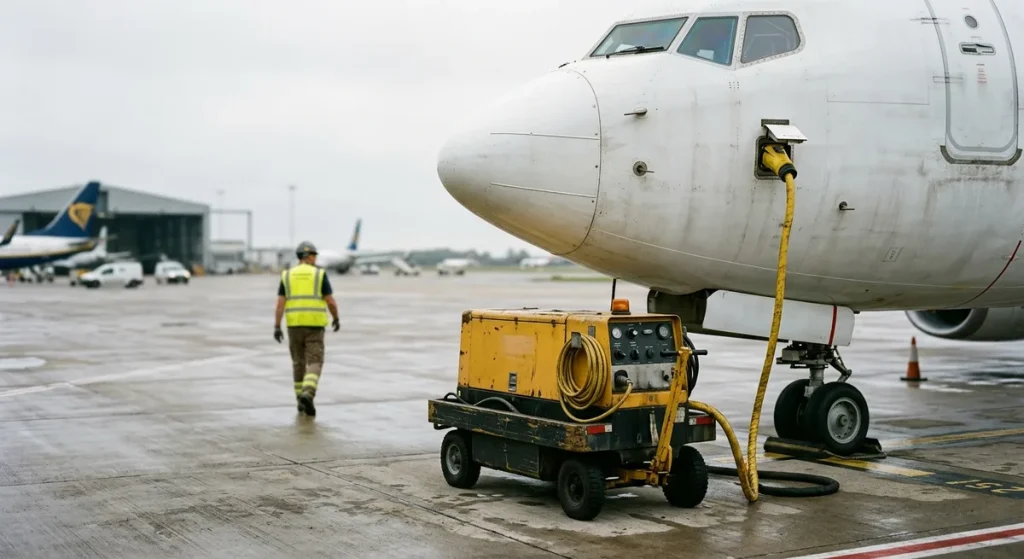
Aviation ground support equipment covers everything that services an aircraft while it is not flying: the machinery parked around a jet at the gate, the tooling in the hangar, and the vehicles shuttling between them. The term spans commercial airlines, cargo operators, business aviation, MRO facilities and the military, where the same functions appear in ruggedized form. An aircraft earns nothing parked at a gate, so every piece of GSE exists to shorten, secure or enable its time on the ground.
GSE splits into powered and non-powered equipment. Powered GSE has its own drive or power source – a pushback tug, a diesel or electric GPU, a catering truck. Non-powered GSE has none: towbars, chocks, dollies, jacks and engine stands are positioned by hand or towed. Non-powered does not mean unregulated – a loaded engine stand or a set of aircraft jacks is load-rated, inspected and maintained with the same seriousness as any vehicle on the ramp, to design and test standards maintained by the SAE AGE committee.
| Type | Examples | Characteristics |
|---|---|---|
| Powered GSE | Pushback tugs, GPUs, ASUs, belt loaders, fuel and catering trucks, apron buses | Own engine or electric drive; needs trained operators, fueling or charging, and preventive maintenance |
| Non-powered GSE | Towbars, chocks, cones, cargo dollies, baggage carts, engine stands, jacks | No drive system; towed or positioned manually; lower upkeep but still load-rated and inspected |
Aircraft systems need power long before and after the engines run. Ground power units feed an airliner’s primary 115/200V three-phase AC system at 400 Hz and usually offer a 28V DC output alongside it – the standard supply for smaller aircraft – from either a mobile diesel unit or a fixed gate installation. Air start units deliver compressed air to spin up a turbine engine when the aircraft’s own APU is inoperative or its use is restricted. Pre-conditioned air units keep the cabin at temperature without burning fuel. The unusual 400 Hz frequency is an aviation legacy standard: it allows onboard electrical components to be smaller and lighter than at household frequencies, so ground equipment adapted to the aircraft rather than the other way around. Together, these units let an aircraft stay fully alive at the gate with its engines and APU shut down, saving fuel and cutting ramp noise – many airports now restrict APU running time at the gate for exactly that reason.
Some aircraft can technically back up on reverse thrust – powerback was once routine on a few types – but ramp procedures all but universally prohibit it, and taxiing in congested gate areas is expensive and risky in any case. Movement GSE fills the gap. Conventional pushback tugs connect to the nose gear through a towbar; towbarless tractors lift and secure the nose wheel on a cradle, which speeds up hookup and takes towbar handling out of the job – always within the towing limits published for each aircraft type. Heavier tow tractors relocate aircraft over longer distances – from a remote stand to the hangar, for example – while chocks, cones and towbars round out the non-powered side of the category. Towing is a deliberate, low-speed operation with wing walkers watching clearances, because a widebody’s wingtips extend far beyond what the tug driver can judge from the cab.
Servicing GSE handles fluids and consumables. Fueling is done either by tanker truck or by a hydrant dispenser that connects the aircraft to an underground fuel network. Separate potable water and lavatory service trucks are kept strictly apart for hygiene reasons. Catering trucks with scissor-lift bodies raise galley carts to cabin door height. In winter operations, de-icing rigs spray heated fluid over wings and control surfaces from a raised, articulated boom – a servicing task with a direct and immediate safety role, performed against the clock because de-icing fluid protects the aircraft only for a limited holdover time before departure.
Belt loaders move loose baggage into narrow-body holds, while wide-body freight travels in unit load devices (ULDs) – standardized containers and pallets that lock into the aircraft’s cargo floor. Dedicated container loaders raise entire ULDs to sill height on scissor platforms and roll them aboard on powered conveyor decks. Baggage tractors pull trains of carts and dollies between the sorting hall and the aircraft. On the passenger side, mobile stairs and apron buses take over wherever a jet bridge is not available, keeping remote-stand operations moving.
Passengers never see this category, but heavy maintenance runs on it. Aircraft jacks lift the airframe for gear swings and weighing. Maintenance platforms give mechanics stable access to tails and pylons. And engine stands – wheeled cradles engineered for a specific engine family – carry engines through changes, shipping and storage. A typical stand pairs a base frame with a cradle that grips the engine at manufacturer-approved mount points, often through shock-absorbing isolators that protect bearings from road and ramp vibration. During an engine change, a bootstrap kit – a set of hoists attached to the engine mounts and the pylon – lowers the engine onto its stand and lifts the replacement into position. Because each stand is built around one engine family’s mount points and center of gravity, fleets need the right stand for the right engine; our overview of aircraft engine stand types breaks the options down.
Planning an engine change or shipment? National Aero Stands rents and leases engine stands for CFM56, LEAP, Trent, GE90 and PW engines, available worldwide.
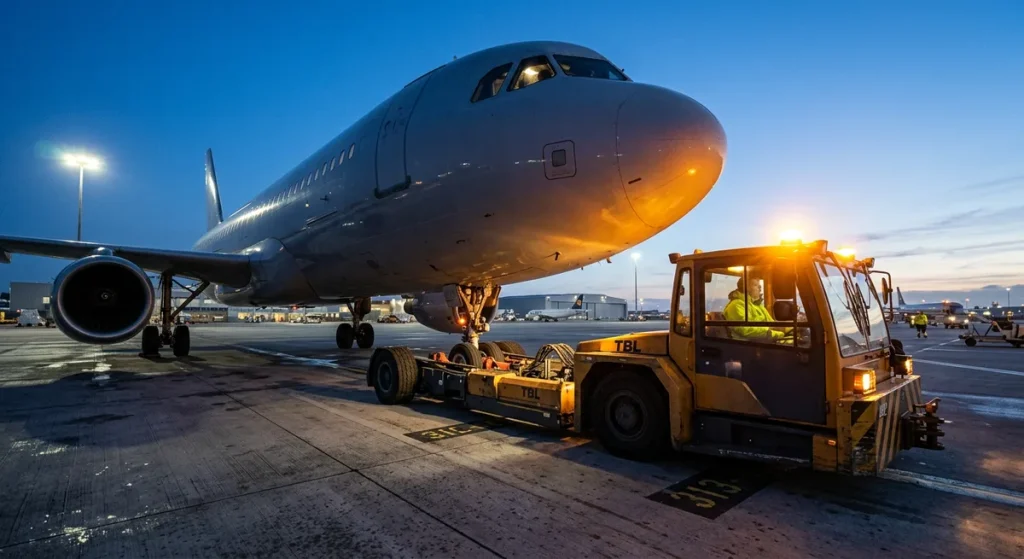
During a standard turnaround, a dozen machines converge on one aircraft on a crowded airport apron, work in parallel for roughly half an hour and clear out before pushback. The faster and more predictably GSE moves through that sequence, the more flying an airline gets out of each airframe. The windows below are typical for a narrow-body turnaround; each airline’s ground operations manual sets its own.
| Task | Equipment involved | Approx. window |
|---|---|---|
| Arrival: chocks, cones, ground power on | Chocks, cones, GPU or fixed gate power | First approx. 5 min |
| Passenger deboarding and boarding | Jet bridge or stairs, apron buses | Runs through most of the turnaround |
| Baggage and cargo exchange | Belt loaders, baggage tractors, dollies | Approx. 5-35 min |
| Fueling | Hydrant dispenser or fuel truck | Approx. 10-30 min |
| Cabin service: catering, water, lavatory | Catering trucks, water and lavatory trucks | Approx. 10-30 min |
| Pushback and engine start | Pushback tug, ASU if required | Final approx. 5-10 min |
A dead GPU or a tug stuck in maintenance does not just slow one task – it pushes the whole sequence right, and the delay propagates through the day’s schedule. That is why ground handling contracts increasingly specify equipment readiness levels alongside staffing, and why handlers track GSE utilization the way airlines track aircraft utilization: an idle loader is sunk cost, but a missing one is a delay code with the airline’s name on it.
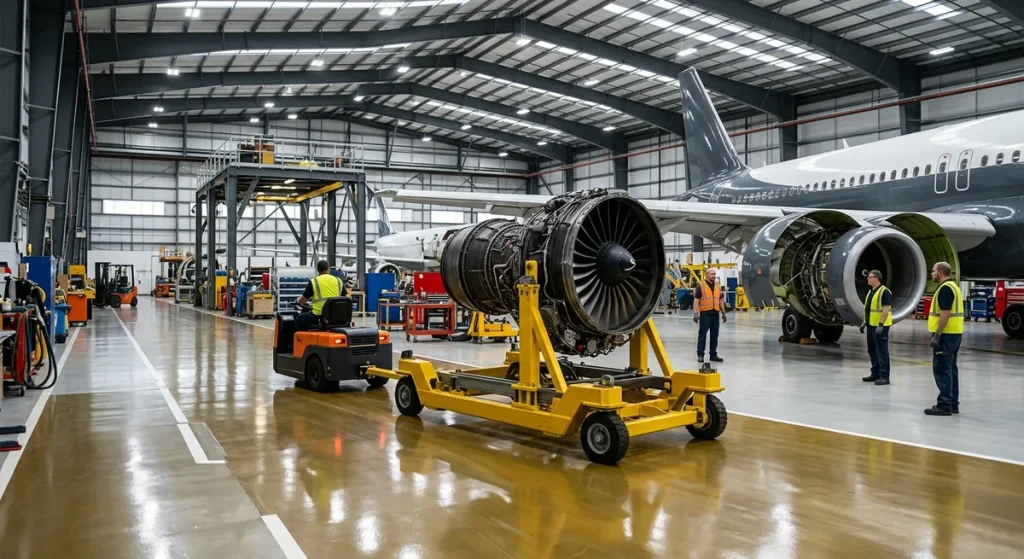
Away from the gate, GSE changes character: less about speed, more about precision and load handling. Hangar work – everything covered by MRO in aviation – leans on jacks, access platforms, component cradles and above all engine stands; in an EASA Part-145 organization that tooling is controlled and inspected under the same approval as the work itself. An engine change is the clearest example: the bootstrap kit lowers the engine from the pylon onto a stand, the stand carries it across the hangar or into a truck. Transport, storage and shop work are not always the same piece of hardware, though: at a shop visit the engine usually comes off onto the shop’s own build-up stand, and a rented transport stand goes back into the pool.
Engine stands therefore sit in a different procurement category than most GSE. A belt loader works every day; at many operators a Trent 700 stand may be needed twice a year, then urgently and immediately, while a large engine shop keeps its stands working week in, week out. That usage pattern often makes rental or leasing the better sourcing model for engine handling equipment, above all for low-frequency events, demand peaks and non-core engine types.
Defense operators use the same functional categories under a different set of constraints. Military aircraft ground support equipment – AGSE in US Army usage, while the US Air Force calls its equivalent AGE, for aerospace ground equipment – must survive rough handling, operate from austere or unpaved locations, and frequently be air-transportable itself. Mobile maintenance shelters, ruggedized power carts, tactical tow tractors and reinforced fuel and water trucks mirror their commercial counterparts with heavier construction and simpler field repair. Engine stands appear here too, built to military specifications for specific engines. We cover the category in depth in our guide to military aircraft GSE.
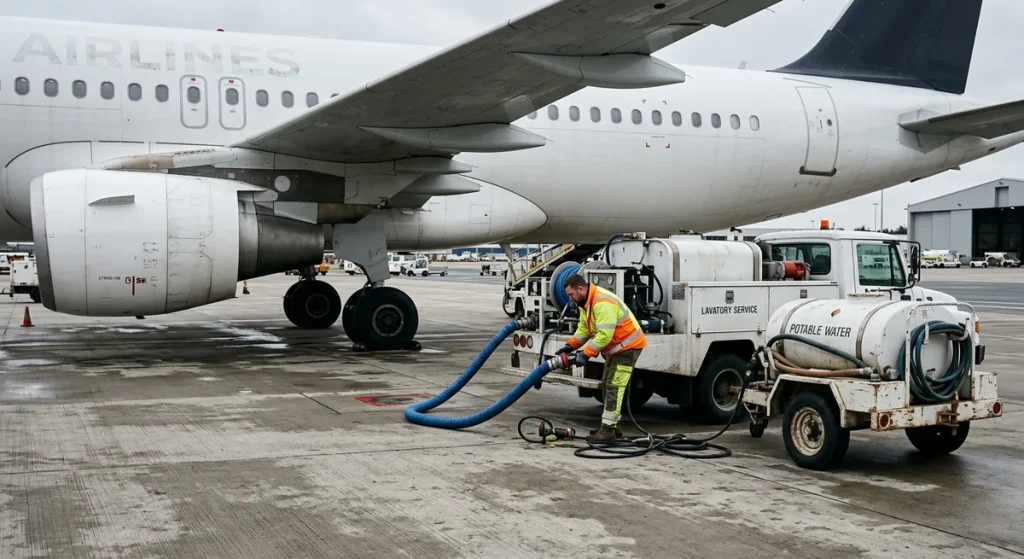
Diesel still dominates the installed GSE base, but replacement purchases are increasingly electric; in the United States the FAA Zero Emissions Vehicles program funds airports converting their fleets. Baggage tractors, belt loaders and smaller pushback tugs went first because their duty cycles suit batteries: short runs, frequent idle periods, home base always nearby. Electric GPUs and larger tugs are following. Ramp crews breathe no exhaust at ground level, noise drops, and there are fewer moving parts to maintain; many airports now write emissions requirements into ground handling licenses. The trade-offs are real too – winter derating, charger uptime, batteries that age with every fast cycle – and charging points compete for the same scarce apron space as everything else, so electrification advances gate by gate rather than fleet-wide overnight. Over a unit’s working life, lower energy and maintenance costs offset the higher purchase price for many duty cycles, which shifts procurement decisions even where no regulation forces the issue.
Heavy machinery working within arm’s reach of a pressurized fuselage – metal or composite – is an inherently unforgiving environment. Ground damage from GSE collisions – a belt loader kissing a cargo door sill, a catering truck against the fuselage – is one of the industry’s persistent cost drivers, and much of it happens at low speed in good weather. Standard defenses include strict approach procedures, guide persons for reversing vehicles, speed limits on the ramp, and FOD (foreign object debris) discipline: a dropped bolt or a torn baggage tag on the apron can end up in an engine inlet, so equipment staging areas are kept clean and walked regularly.
Non-powered equipment has its own failure modes. An unsecured engine stand, an unrated lifting point or a jack on soft ground can damage an engine or injure a technician in seconds. Load ratings, inspection tags and securing protocols exist precisely because this category looks harmless and is not.
Sourcing strategy depends on utilization. Equipment used daily – tugs, loaders, GPUs – is usually bought new or used and run through a structured maintenance program. Buying new brings warranties and current emissions compliance; the used market cuts capital cost for operators who can absorb more maintenance risk. Equipment used episodically – engine stands above all – is more often rented or leased, so the cost appears only when an engine change, shipment or storage project actually happens.
Before any purchase or rental contract is signed, four checks matter:
The equipment is rarely the expensive part. The expensive part is the aircraft standing still behind a missing tug – or an engine change on hold because the right stand is weeks away.
GSE stands for ground support equipment: the vehicles, machinery and tooling used to service aircraft on the ground. It covers everything from pushback tugs, ground power units and fuel trucks to non-powered items such as chocks, towbars, jacks and engine stands.
The usual industry breakdown runs to five groups: power and starting (GPUs, air start units), aircraft movement equipment (tugs, tractors, towbars), servicing equipment (fuel, water, lavatory, de-icing, catering), loading and passenger handling (belt and container loaders, stairs, buses), and engine and component handling (engine stands, jacks, platforms).
AGSE stands for aircraft (or aviation) ground support equipment, an abbreviation used mainly in US Army aviation and parts of the aerospace industry; the US Air Force uses AGE (aerospace ground equipment) for the same category. In practice it covers the same categories as commercial GSE, in ruggedized and often air-transportable form – including engine stands built to military specifications.
Yes. Engine stands belong to the engine and component handling category of GSE, alongside jacks, bootstrap kits and maintenance platforms. They are non-powered GSE: no drive system, but strict load ratings, engine-family-specific cradles and regular inspections, since a single stand carries an asset worth millions.
Powered GSE has its own drive or power source – tugs, GPUs, belt loaders, fuel and catering trucks – and needs operators, fuel or charging, and preventive maintenance. Non-powered GSE, such as towbars, chocks, dollies, jacks and engine stands, is towed or positioned manually but remains load-rated and inspected.
It varies by airport and contract. Ground handling companies operate most gate equipment, airlines often own fleets at their hubs, airports provide fixed installations such as gate power, and MRO facilities keep their own maintenance GSE. Specialized items like engine stands are frequently rented from dedicated providers as needed.