

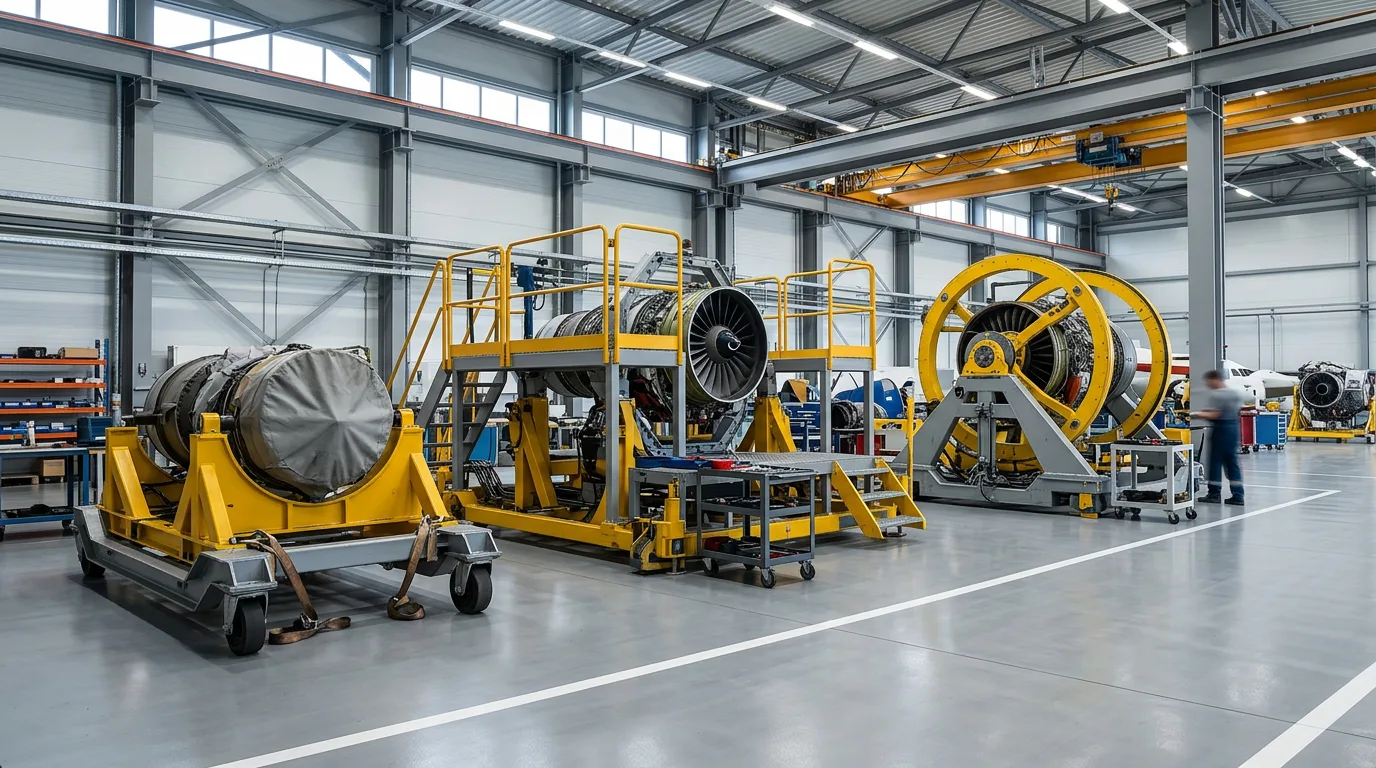
Aircraft engine maintenance stands fall into four working types: transport (shipping) stands, storage stands, maintenance and access stands, and rollover stands – with the bootstrap kit as separate engine-change tooling that works alongside them. Each stand holds a multi-million dollar engine during a different phase of its ground life, and each is defined by hard specifications: load capacity, cradle interface, shock mount rating, tie-down points and engine model compatibility. Get the cradle or the load case wrong and the consequence is concrete – a rejected shipment, a damaged mount or an insurer refusing the move.
The main types of aircraft engine stands
Engine support stands hold propulsion systems securely during maintenance, repair, overhaul and logistics. No single design covers the whole job: a stand built for a 2,000-mile truck ride is not built for working height in the hangar, and neither it nor an access platform can rotate an engine for module access. Four stand types do the holding; the bootstrap kit, though not a stand itself, appears alongside them because on-wing engine changes depend on it.
| Equipment | Primary job | Defining features |
|---|---|---|
| Transport / shipping stand | Move an engine by road, air or sea without damage | Shock mounts, certified tie-down points, tow-capable base, OEM-approved cradle |
| Storage stand | Hold a preserved engine for weeks to years | Stable static base, works with sealed engine bags and desiccant preservation |
| Maintenance / work stand | Give technicians safe access during shop and line work | Adjustable platforms, guardrails, fall restraint, protective padding |
| Bootstrap kit (engine-change tooling) | Remove and install an engine on-wing without a crane | Hoists, beams and adapters that mount to the pylon or nacelle strut |
| Rollover / turnover stand | Rotate the engine for access to all sides | Rotation mechanism with locking positions, reinforced cradle |
Test stands are a separate category and are not covered here. An aircraft engine test stand is a facility that runs a live engine and measures thrust, temperatures and vibration – a different tool entirely from the support stands below, which only ever hold a shut-down engine. Search listings mix the two constantly, so always check which one a supplier actually means.
Transport and shipping stands
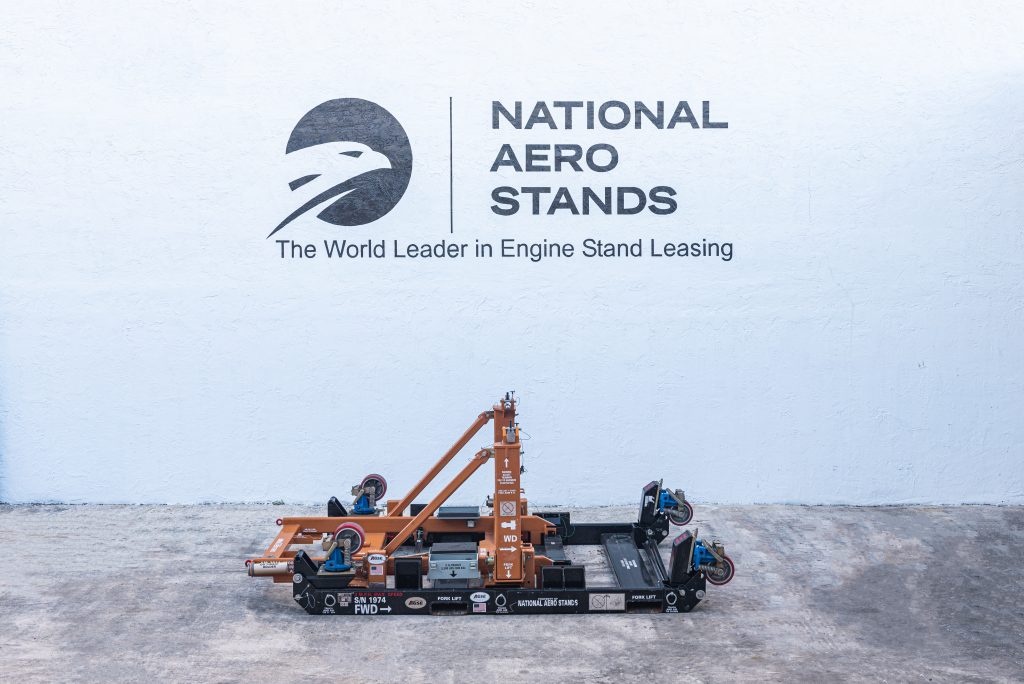
Nearly every engine move starts and ends on a transport stand, which usually splits into two parts: a cradle shaped to the engine’s mounting points and a base frame that rides on casters or a trailer. Between them sit the shock mounts – elastomeric isolators that absorb road bumps and handling shocks so they never reach the engine’s bearings, gearbox and accessories. Certified tie-down points let crews strap the loaded stand to a truck bed or a freighter main deck, and the base geometry is designed around real-world constraints: air-ride trailer dimensions, cargo aircraft door limits and warehouse door heights.
Because the cradle carries the engine at its actual mount points, transport stands are model-specific and built to engine manufacturer requirements. A 737NG operator ships its engines on a dedicated CFM56-7B engine stand; the same base frame may accept a different cradle, but each cradle fits one engine family only. For air transport, an approved stand is one prerequisite among several: carrier-specific restraint requirements, aircraft loading limits and the stand and engine makers’ shipping instructions all have to be met, with IATA and ICAO guidance on securing heavy cargo in the background. Road, air and sea each add their own constraints – our aircraft engine transportation guide covers them mode by mode.
Storage stands
An engine waiting for its next shop visit or lease placement can sit for months, and storage is its own discipline. The stand must carry the full static load indefinitely without settling, keep the engine at a safe height off the floor, and work with the preservation system: a sealed engine bag, desiccant charges and humidity indicators that protect internals from corrosion. Preservation has its own calendar – operators re-inspect the bag and desiccant at set intervals and re-preserve the engine if storage stretches past program limits. How the preservation program actually runs – oils, desiccant charges, humidity limits, re-inspection intervals – is the subject of our aircraft engine storage guide.
Many operators keep a stored engine on its transport stand configuration, provided the cradle is rated for extended static load. That is convenient – the engine can leave the warehouse the day it is sold or called to a shop – but it is also why stand availability directly limits how many spare engines a facility can hold. Climate-controlled warehousing adds a further layer of protection for long-term staging; bonded status, sometimes mentioned in the same breath, is a customs arrangement and protects nothing but cash flow.
Maintenance and access stands
Two different things hide under the maintenance stand label. In the shop, the engine itself sits in a cradle – often its own transport stand – while separate access equipment gets people to it safely. Adjustable-height platforms bring technicians level with the component they are working on, and heavy padding on rails and platforms protects the engine and airframe from accidental contact during close-quarters maneuvering. Guardrails and integrated fall restraint can reduce the need for separately rigged fall protection on specific tasks, depending on the stand design and local safety rules. Mobile bases let the whole structure roll up to an installed engine, which makes access stands part of the standard AOG (aircraft on ground) response kit for line stations.
Purpose-built variants exist for specific airframes – business jet access stands shaped around tail-mounted engine pods are a good example – while modular platforms with interchangeable adapters cover mixed fleets. In the shop, work stands also host QEC (quick engine change) buildup, where accessories, harnesses and plumbing are dressed onto a bare engine before installation.
Bootstrap kits
A bootstrap kit is not a stand at all – it is engine-change tooling: a set of hoists, beams and adapters that bolt to hard points on the pylon or nacelle strut, so the aircraft’s own structure becomes the lifting frame. It earns its place in this guide because it never works alone: crews lower the removed engine onto a waiting transport stand, or raise the replacement from one, using controlled, synchronized hoisting instead of a crane. That is how an engine gets changed at an outstation with no hangar.
Bootstrap kits are specific to the engine-and-airframe combination, and they travel: an operator dispatching an AOG team ships the kit and a compatible transport stand together, because one is useless without the other. For airlines flying long thin routes, pre-positioning bootstrap kits and stands at key stations is a standard piece of AOG risk planning.

Rollover and turnover stands
Some tasks need the engine at an angle no fixed cradle allows: module swaps, QEC buildup on the underside, borescope access or repairs to lower-case components. A rollover stand (also called a turnover stand) holds the engine in a reinforced cradle that rotates about the engine’s long axis, with mechanical locks at set positions so technicians work on a fixed, stable unit rather than a suspended load.
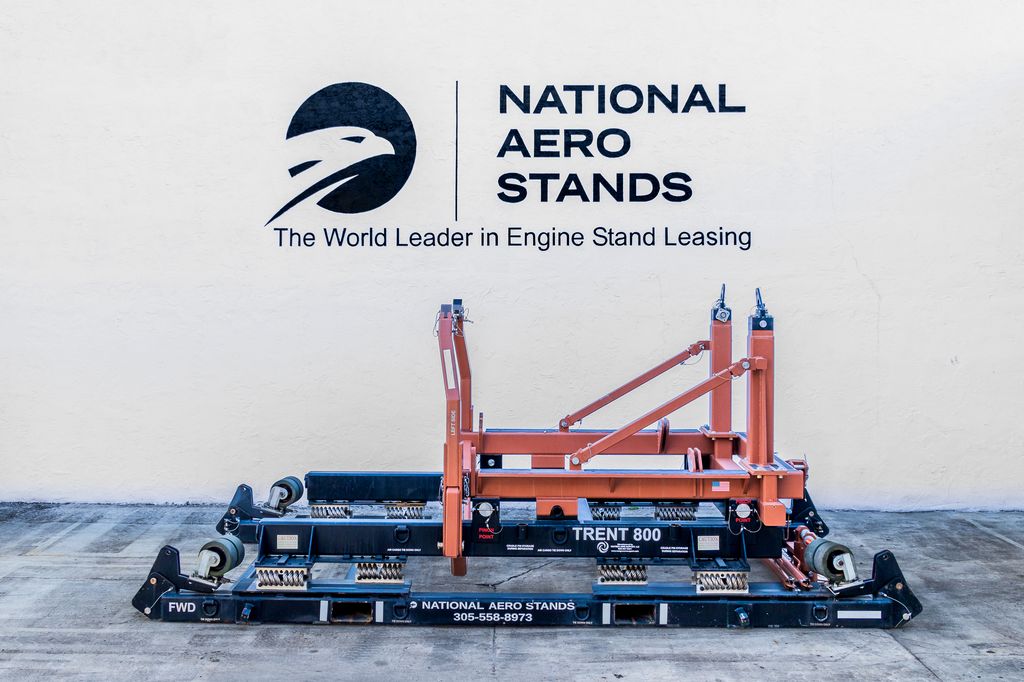
The bigger the engine, the more this capability matters. A Trent 800 weighs approx. 5.9-6.1 t (13,000-13,400 lb) dry per Rolls-Royce Trent 800 data – at that scale, safe rotation generally requires purpose-built, OEM-approved handling tooling, and many widebody engine shops specify dedicated rollover capability for exactly this reason.
Need a Trent 800 rollover stand? National Aero Stands has rollover-capable Trent 800 stands available for rent and lease.
How to read engine stand specifications
Specification sheets decide whether a stand is safe for your engine and legal for your route. The lines below carry that decision, whoever built the stand.
| Specification | What it defines | Why it matters |
|---|---|---|
| Load capacity | Maximum engine weight the stand carries, with safety margin | An undersized stand risks structural failure under a multi-tonne engine |
| Cradle interface | Which engine model and mount configuration the cradle fits | A wrong cradle puts point loads on structures never meant to carry them |
| Shock mount rating | Vibration and shock isolation performance | Protects bearings and accessories during road and air transport |
| Tie-down and lifting points | Certified attachment points for straps, forks and cranes | Required for safe securing on trucks and freighter decks |
| Dimensions and tare weight | Footprint, height and the stand’s own weight | Determines fit in trailers, cargo doors and storage racks |
| Tow speed limit | Maximum speed when moving the loaded stand | Exceeding it defeats the shock mounts and voids the approval |
| OEM approval / compliance | Conformity with engine manufacturer stand requirements | Many lessors and insurers refuse engines shipped on non-approved stands |
Custom stands exist for unusual engines and procedures, but they follow the same logic: the engine manufacturer defines the mounting geometry and load cases, and the stand is engineered, tested and documented to meet them.
Pre-use checklist: before the engine touches the stand
- Confirm the cradle part number matches the engine model and mount configuration.
- Check load capacity against the engine’s actual as-handled configuration – bare, shipping or dressed (QEC) – per the stand and engine documentation.
- Inspect shock mounts, tie-down points and casters for damage or deformation.
- Verify the stand’s inspection and re-certification dates are current.
- Confirm tow speed limits and route clearances for the planned move.

Engine stand compatibility by engine model
Compatibility is the first filter in any stand search, because the cradle is shaped to one engine family’s mount points and weight distribution. Narrowbody engines leave some room for shared bases; widebody engines rarely leave any.
| Engine | Aircraft application | Approx. dry weight |
|---|---|---|
| CFM56-7B | Boeing 737NG | approx. 5,200 lb / 2,370 kg |
| LEAP-1B | Boeing 737 MAX | approx. 6,100 lb / 2,780 kg |
| V2500 | Airbus A320ceo | approx. 5,300 lb / 2,400 kg |
| PW1100G-JM | Airbus A320neo | approx. 6,300 lb / 2,860 kg |
| Trent 800 | Boeing 777 | approx. 13,000-13,400 lb / 5,900-6,100 kg |
| GE90-115B | Boeing 777-300ER | approx. 18,300 lb / 8,300 kg |
Modular bases with interchangeable cradles let a fleet operator cover several narrowbody types with fewer base frames, while widebody engines almost always demand dedicated hardware. Dry weight is only the starting point for load capacity checks: a dressed engine carries additional accessories and plumbing, from hundreds of pounds on a narrowbody to far more on a widebody, so take the as-handled weight from the engine’s own documentation rather than assuming a fixed margin.
Inspection, lifecycle and safe use
An engine stand is load-bearing ground support equipment, and it ages like any other structure. Facilities track each stand through acquisition, service, mid-life review and retirement, with routine inspections as the backbone: visual checks before every use, periodic non-destructive testing of weld joints and load-bearing pins, verification of shock mount condition and re-certification of load capacity at set intervals. Workplace safety regulations for raised work platforms apply to work stands on top of the aviation-side requirements. The FAA Aviation Handbooks cover engine handling and hoisting practice for maintenance technicians, and repair stations certificated under 14 CFR Part 145 must control and maintain the equipment and tools they use – engine stands included.
A stand whose specifications no longer match the engines in the fleet, or whose structure shows fatigue, comes out of service before it can turn a routine engine move into an incident report. Most facilities set retirement criteria in advance – age, load cycles, inspection findings – so the decision does not wait for a failure.
Renting vs buying engine stands
Stand demand follows shop visit schedules, which surge and fall, so a full set of owned stands spends most of its life as idle capital in painted steel. The arithmetic favors renting for the weeks an engine is actually moving and owning only what stays in daily use: a line station with regular engine changes keeps its own base, while an operator facing one shop visit a year takes a cradle on rent for the duration. National Aero Stands supplies aircraft engine stands for rent and lease across the CFM56, LEAP, Trent, GE90 and PW families, with transport, storage and rollover configurations matched to the engine model, not approximated to it.
FAQ: types of aircraft engine stands
What are the main types of aircraft engine stands?
Four stand types cover most operations: transport (shipping) stands for moving engines by road, air or sea; storage stands for preserved engines; maintenance and access stands for shop and line work; and rollover stands that rotate the engine for all-around access. Bootstrap kits – hoisting tooling for on-wing engine changes without a crane – are related equipment used together with a transport stand.
What is a bootstrap kit in aviation?
A bootstrap kit is engine-change tooling rather than an engine stand: a set of hoists, beams and adapters that attach to hard points on the aircraft’s pylon or nacelle strut, turning the airframe itself into the lifting frame. It lets a crew remove or install an engine at a station with no crane, lowering the engine directly onto a compatible transport stand.
What does a rollover engine stand do?
A rollover (turnover) stand holds the engine in a reinforced cradle that rotates about the engine’s long axis and locks at set positions. Technicians use it for module swaps, QEC buildup and access to lower-case components – work that is impractical or unsafe with the engine fixed in one orientation or hanging from a hoist.
Are engine stands interchangeable between engine models?
No. The cradle is shaped to one engine family’s mount points and is built to engine manufacturer requirements, so it stays with one engine family. Some modular systems share a common base frame across several cradles, which reduces fleet tooling costs, but the cradle-to-engine match remains model-specific.
Which specifications matter most when choosing an engine stand?
Load capacity against the engine’s actual as-handled weight, cradle interface for the exact engine model and mount configuration, shock mount rating for transport, certified tie-down and lifting points, dimensions for trailer and cargo door fit, tow speed limits, and OEM approval. A gap in any one of them shows up later as a rejected shipment, a refused insurance claim or a damaged engine.
How long can an engine stay on a storage stand?
As long as the stand is rated for extended static load and the engine’s preservation program is maintained – typically a sealed bag with desiccant and humidity indicators, re-inspected at set intervals. The stand itself must stay within its own inspection and re-certification dates for the whole storage period.