Ground operation

Ground operation
Long-term aircraft engine storage means protecting an engine against corrosion and moisture damage whenever it will sit idle for more than a few weeks. The process combines preservative oils applied per the engine manufacturer’s manual, desiccants with humidity indicators, sealed bagging and a dedicated storage stand, followed by scheduled inspections until the engine returns to service. Proper preservation protects an asset worth millions of dollars, while a skipped or improvised job can push a parked engine into an early overhaul.
Key takeaways
While an engine runs, circulating oil keeps a protective film on its bearings, gears, shafts and seals. Once the engine stops turning for good, that film slowly drains away. The gas path was never oil-wetted in the first place – compressor and turbine hardware relies on covers, dry air and desiccant, which is exactly what preservation has to supply. Atmospheric humidity then condenses on internal steel surfaces every time the temperature drops overnight, and each condensation cycle deposits fresh moisture exactly where it does the most harm.
Modern engines make this worse, not better. Tolerances on bearings, fuel metering components and blade roots are tight enough that even minor pitting can put a part outside limits. What looks like light surface rust after a year outdoors can mean rejected hardware at the next shop visit – and on a commercial turbofan, that difference is measured in hundreds of thousands of dollars.
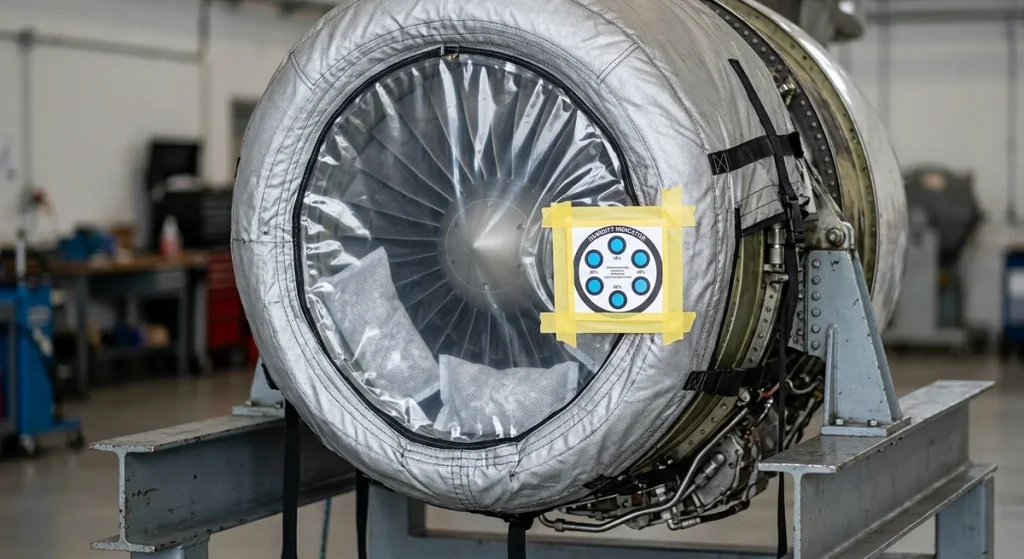
Preservation effort scales with planned downtime. The industry broadly distinguishes active storage, where the engine is kept close to flight-ready and periodically run or motored, from passive storage, where the engine is fully preserved, sealed and monitored. Exact time thresholds differ between engine types and manufacturers, so the tiers below are typical rather than universal.
| Storage tier | Typical duration | Approach | Typical measures |
|---|---|---|---|
| Active (short-term) | Up to approx. 30-90 days | Engine kept near flight-ready | Inlet and exhaust covers, periodic ground runs or dry motoring, visual checks |
| Intermediate | Approx. 90 days to 1 year | Partial preservation | Preservative or inhibiting oil in the oil and fuel systems, desiccant at openings, sealed covers |
| Long-term (passive) | Beyond approx. 1 year | Full preservation and isolation | Complete fluid preservation, desiccant with humidity indicators, sealed or VCI bagging, storage stand, scheduled inspections |
An engine expected back on wing in six weeks does not need full bagging. An engine parked for a lease transition of unknown length should be treated as long-term from day one – re-preserving an engine that was sealed too casually costs far more than the extra bagging would have.
A preservation sequence starts before shutdown. Where the engine can still be operated, teams run it long enough to bring the oil to full operating temperature, which evaporates accumulated moisture and acidic combustion by-products out of the lubrication system. An engine preserved with contaminated, moisture-laden oil starts its storage life already compromised.
After the final run, the work moves system by system, following the engine manufacturer’s preservation instructions:
What follows is monitoring rather than maintenance: desiccant holds the sealed atmosphere dry, and indicator readings logged at each check prove that it stayed that way.
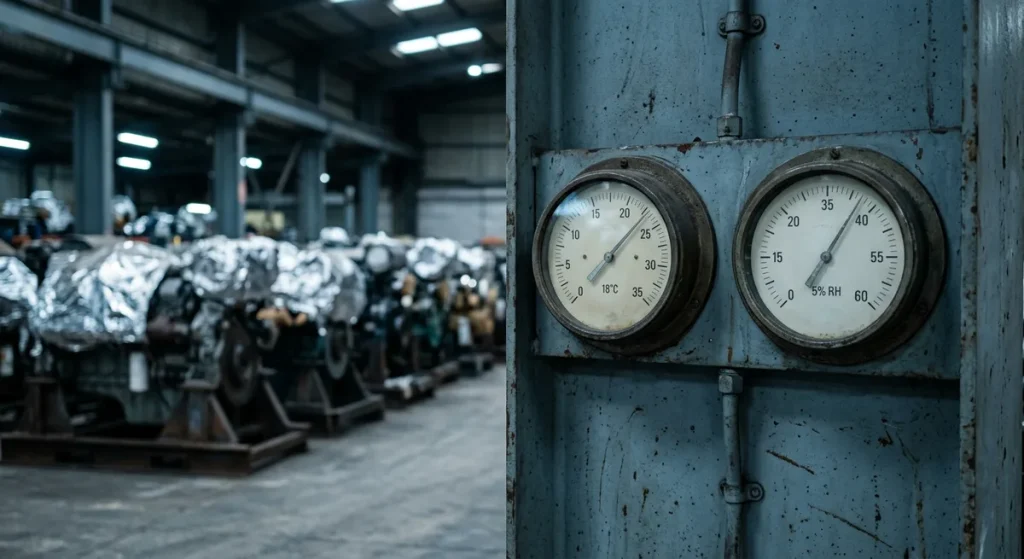
Sealing an engine traps a volume of air inside, and that air carries moisture. Desiccant – typically silica gel in bags or dehydrator plugs – absorbs it. Classic indicating gel is deep blue when dry and turns pink as it saturates; many current indicators use orange-to-green chemistry instead, but the principle is the same: a color you can read at a glance without breaking the seal. Humidity indicator cards mounted behind windows in the bagging do the same job for the whole envelope.
For genuinely long-term storage, many operators go one step further and bag the entire engine in barrier film, often with volatile corrosion inhibitor (VCI) material that releases a vapor which passivates metal surfaces inside the sealed volume. Exact thresholds vary by preservation scheme, but most programs converge on keeping the environment around and inside the engine below approx. 40-50% relative humidity – dry enough that corrosion chemistry effectively stalls.
| Method | What it does | Where it is used |
|---|---|---|
| Desiccant (silica gel bags, dehydrator plugs) | Absorbs moisture trapped inside the sealed envelope | Engine openings, inside bagging |
| Humidity indicators (cards, indicating plugs) | Visual moisture check without breaking seals | Bag windows, dehydrator plugs |
| VCI film or bagging | Releases corrosion-inhibiting vapor around metal surfaces | Long-term sealed storage |
| Preservative and inhibiting oils | Leaves a protective film on internal wetted surfaces | Oil system, fuel system, cylinders |
| Controlled storage environment | Keeps ambient humidity low and temperature stable | Indoor, off-ground warehouse storage |

Where the engine physically sits during storage is as important as how it is sealed. A purpose-built engine stand supports the engine at the mount points approved by the manufacturer and keeps it clear of floor moisture. Just as important over a long storage period, the engine can be inspected, relocated or loaded for shipment without re-rigging the cradle. Stands with shock-absorbing cradles also protect bearings from vibration when a stored engine does have to be relocated. Pallets, improvised cradles or resting an engine on its cowling risk structural damage that no amount of desiccant will fix. Our overview of aircraft engine stand types explains how storage stands differ from transport and maintenance configurations.
Need a Trent 800 engine stand for storage or shipping? The Trent 800 engine stand is available for rent and lease from National Aero Stands.
Because storage periods are often open-ended, renting a stand is common practice: it avoids tying up capital in hardware that may sit under an engine for years. National Aero Stands keeps engine stands for CFM56, LEAP, Trent, GE90 and PW engine families available for exactly this scenario.
General aviation piston engines follow the same logic with different mechanics, and the practices are documented in the FAA’s Aviation Maintenance Technician Handbook – Powerplant. The final ground run should bring oil temperature into the normal operating range – approx. 180-220°F for most types – and hold it there long enough to drive off moisture and acids; how long that takes is set by the engine maker’s service guidance, not by a universal clock. Crews then remove the spark plugs and spray CPC directly into the combustion chambers while rotating the engine, coating cylinder walls before the bores are sealed. Dehydrator plugs with indicating silica gel screw into the spark plug bores, and moisture-proof tape and cowl plugs seal the exhaust, breather and carburetor intake.
Where the aircraft is parked matters too: standing over grass or bare dirt raises local humidity and measurably accelerates corrosion compared to pavement or hangar floor.
A few practices to avoid, because they cause real damage:

The inspection interval depends mainly on the storage environment. In a dry, arid climate, a documented visual check of seals, covers and indicators approx. every 90 days may be adequate. In humid coastal environments, dehydrator plugs and indicator cards deserve attention weekly, because desiccant saturates far faster and a color change is the only early warning you get.
Every check should be logged: which indicators were read, which desiccant was replaced, what the ambient conditions were. For leased or stored assets awaiting sale, that paper trail is part of the engine’s value – a buyer or lessee will ask how the engine was kept, and records are the only credible answer.
Depreservation deserves the same discipline as preservation. Rushing it risks foreign object damage and mechanical harm from residual preservation materials. A typical return-to-service sequence looks like this:
If the engine is headed to a shop visit rather than back onto the wing, it will travel on the same stand it was stored on – our guide to jet engine transportation covers what that move involves. If the engine crosses a border on the way, the aircraft engine shipping process – purge confirmation, customs paperwork, shock indicators – comes on top.
There is no single universal storage regulation. The binding requirements come from the engine manufacturer’s manuals – the preservation and storage chapters of the engine maintenance manual and the related instructions for continued airworthiness. On commercial engines the work is typically carried out or overseen by repair stations certificated under 14 CFR Part 145 or the EASA equivalent, and 14 CFR Part 43 governs who may perform and sign for the tasks. Military operators apply their own long-term packaging and preservation specifications, and lessors add return conditions on top. A stored engine that comes with complete preservation records sails through redelivery; one without them gets opened up, borescoped and argued over.
How long can an aircraft engine sit without preservation?
Not long. Once regular operation stops, oil films drain and corrosion can begin within weeks, faster in humid climates. Depending on the manufacturer, the first preservation steps can be required after as little as approx. 7 days of expected inactivity, with fuller preservation at approx. 30 and 90 day thresholds. The engine’s own manual defines the exact limits. What humidity level is recommended for engine storage?
Most preservation schemes target below approx. 40-50% relative humidity inside the sealed envelope and in the storage area, because corrosion chemistry slows dramatically in dry air. In practice crews manage to the indicators: when a card or plug shows the envelope creeping toward the limit, the desiccant is replaced rather than left to saturate. Do stored engines need to be run periodically?
Only in active, short-term storage, where periodic ground runs or dry motoring keep oil distributed and the engine flight-ready. In passive long-term storage the engine is not run at all; protection comes from preservative fluids, desiccant and sealing, verified through scheduled visual inspections instead. Can an engine be stored on its transport stand?
Yes, and it usually should be. A purpose-built stand supports the engine at OEM-approved mount points, keeps it off the floor and away from ground moisture, and lets the engine be moved or shipped without re-rigging. Many operators rent a stand for the full storage period. What does jet engine storage cost?
There is no standard figure – cost depends on warehouse space and climate control, preservation labor and materials, stand rental, insurance and periodic inspections. Passive long-term storage costs more to set up but little to maintain; active storage is cheaper up front but consumes labor continuously. What is VCI packaging?
VCI stands for volatile corrosion inhibitor. VCI film or bagging slowly releases a vapor that settles on metal surfaces inside a sealed volume and interrupts the corrosion reaction. Combined with desiccant and humidity indicators, it is a standard element of long-term engine bagging.