Ground operation

Ground operation
An engine sling is the lifting fixture that links an aircraft engine to a hoist, so the hoist carries the engine while it is unbolted and moved to or from its stand. The FAA powerplant handbook sets the order: the sling goes on before the engine is freed, the hoist must have enough capacity, and the engine’s center of gravity has to be taken into account. This guide walks through the transfer and the equipment specifications behind it.
There is no universal procedure. The FAA handbook states that procedures for removing or installing an aircraft engine usually vary widely with the type of aircraft and the type of engine, so no single list of instructions covers all engines. Its standing advice is to reference the applicable manufacturer’s instructions before any phase of engine removal or installation.
Commercial operators usually rely on the quick-engine-change assembly (QECA), also called the engine power package. Whatever the package, the sling comes first: before the engine can be freed from its attachment points, a sling must be installed so the hoist supports the engine’s weight when the mounting bolts are removed.
Engines and QECAs have marked points for attaching the sling. Their location varies with the size and weight distribution of the engine.
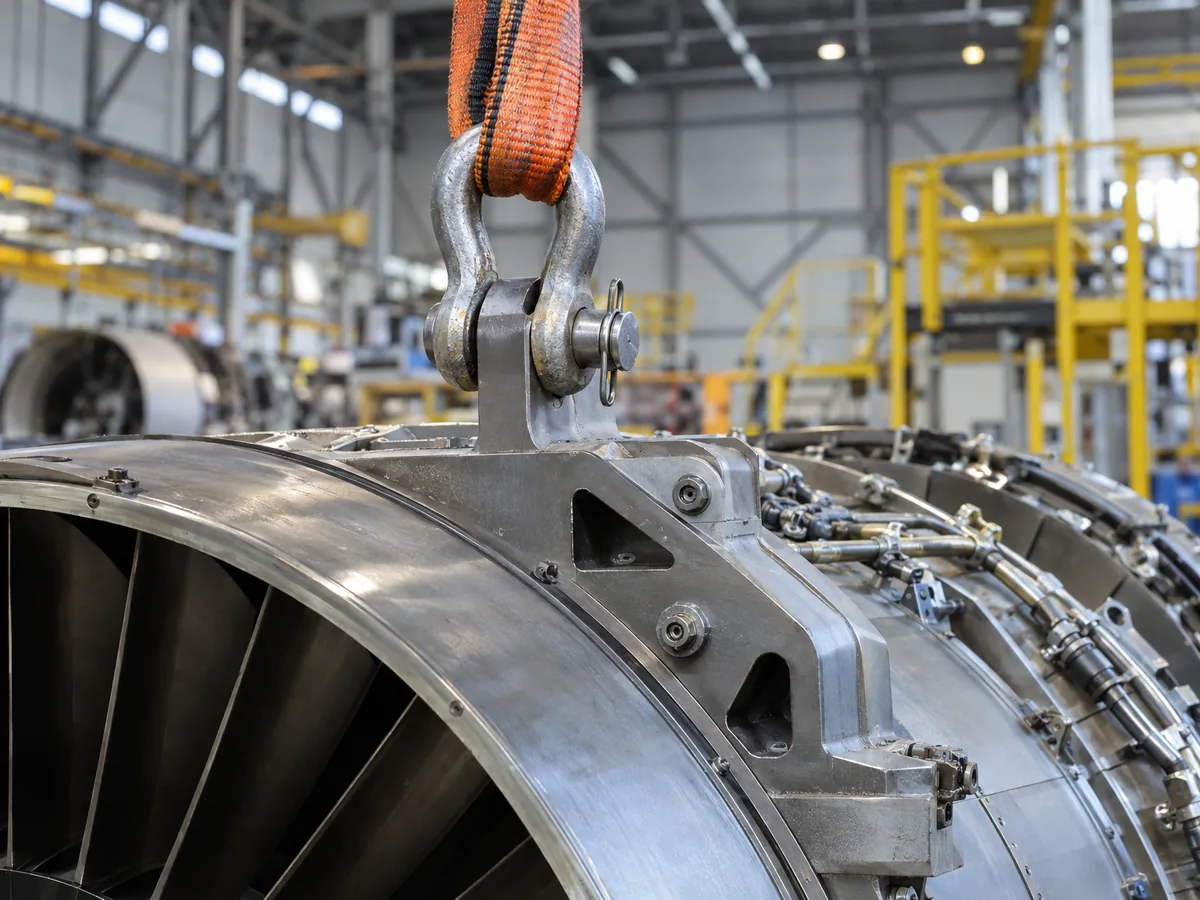
The FAA sequence for lifting an engine out, in the order the handbook gives it:
The handbook’s turbine engine QECA procedure, an example that includes propeller control rods, makes two further points about removal. The sling must be adjusted so the hoisting eye sits over the QECA CG, or the engine may be damaged. And the QECA is lowered onto its stand and secured before the sling is removed.
Throughout the lift, the handbook adds, the engine’s center of gravity (CG) should be taken into account. The stand side of this transfer is covered in our guide to the aircraft engine cradle and stand base.
For installation, the stand with the replacement engine is moved as close as possible to the nacelle, the sling is attached and the hoist hooked to it. Slack is taken up until the hoist supports most of the engine weight, and only then are the bolts that hold the engine to the stand removed. When the hoist frame moves, the engine must be steadied to prevent injury to the crew or damage to the aircraft or engine. While the mount nuts are tightened, the hoist should support the engine weight sufficiently to allow alignment of the mounting bolts.
After the mount nuts are safetied and the sling and hoist are removed, bonding strips are connected across each engine mount to provide an electrical path from the mount to the airframe.
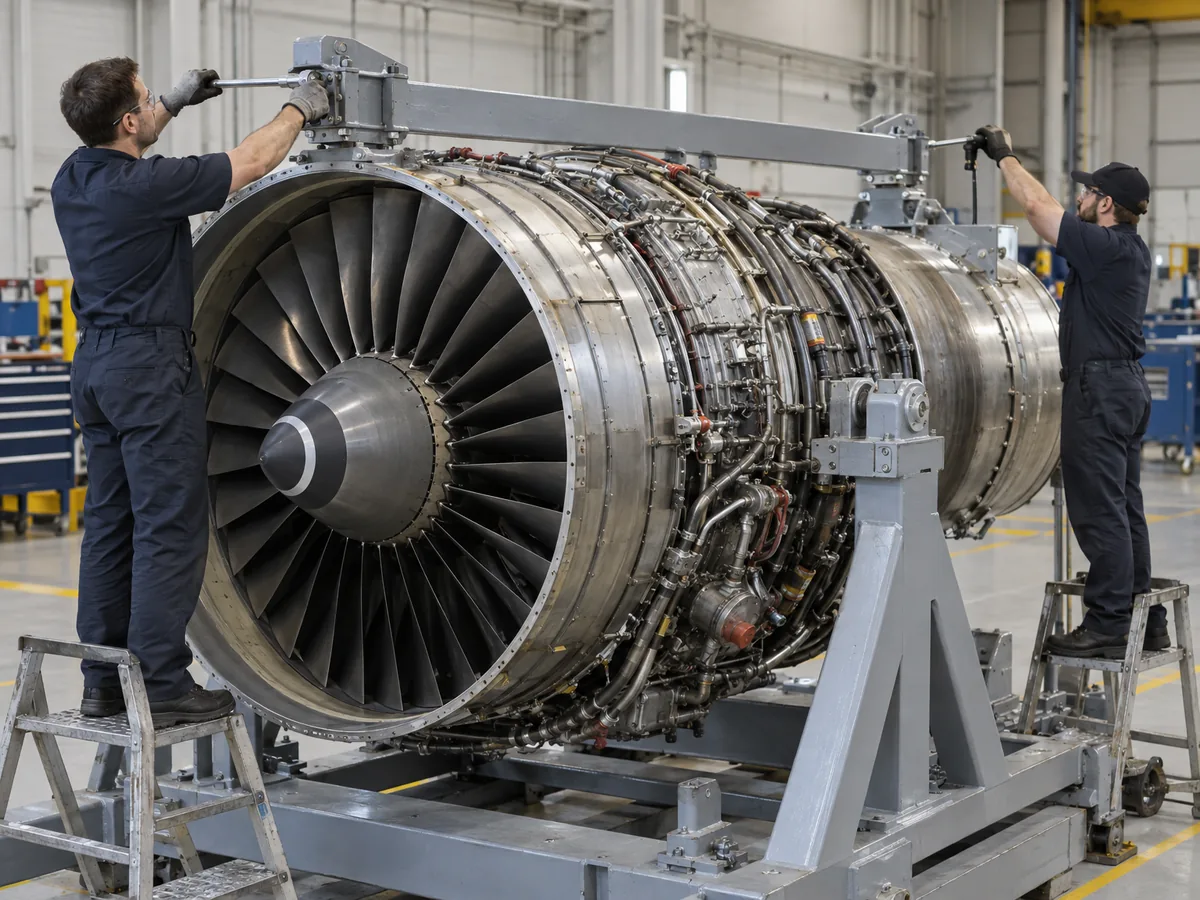
Published sling specifications show how far capacity and attachment design vary from one engine family to the next.
| Sling | Engines accommodated | Maximum load capacity |
|---|---|---|
| AGSE 9C1189 (aft sling) | GE90-115B, GE90-94B | 8,000 lbs (3,629 kg) |
| AGSE 10C1288 | CF34-10E | 7,500 lbs (3,402 kg) |
| AGSE-L012-G01 | CF6-50, CF6-80C2, CFM56-3, RB211-535, V2500-A1/A5 | 16,000 lbs (7,257 kg) |
The AGSE 10C1288 has a telescoping tool that adjusts the CG from the ground and a lifting eye and trolley assembly. The AGSE-L012-G01 is a universal design: a body, two spreader beams and cable assemblies, with the lifting shackle setting the CG, and the sling itself weighs 1,550 lbs (703 kg). For the GE90, AGSE lists a separate 9C1190 forward propulsor sling for the GE90-94B next to the 9C1189 aft sling.
The Hydro HG family takes a modular route. It is built around a basic I-beam with a hand-wheel adjustable suspension and engine-specific adapter kits. One beam accepts front and rear adapters to match multiple engine types and mounts, and the hand-wheel aligns the lift point for controlled, balanced hoists. Hydro rates the heavy-lift variants of the family up to 9 t. The front and rear adapters secure the engine to the beam before lifting starts. Hydro recommends engine-specific adapter kits per model with the supplied operation and maintenance manuals, and states that original engine bolts are not included and must be provided as required by procedure. Test certificates validate performance within the specified nominal and test loads for each variant.
For stand selection on the same engine types, see our overview of aircraft engine maintenance stand types.
A hoist frame is not the only option on the wing. According to Hydro/RH Aero, its COBRA Universal Engine-Change System is an OEM-validated alternative to bootstrap beams: a four-pillar, semi-automatic rig that lifts and positions a wing-mounted power plant, with a touchscreen that records loads and inclinations for AMM compliance. The manufacturer lists overload sensors and an emergency-lower function, and quick-change beams that link to all common engine cradles, with dedicated sets for GE90, Trent 1000, LEAP, PW1100G and PW1500G. It states that a 2025 upgrade raises capacity to 18 t for lifts up to 1.5 m. The manufacturer claims changes up to 70% faster than bootstrap, quoting 1 h 55 m for an A320/CFM56 change and 5 h 30 m for a 777/GE90. Hydro/RH Aero also states that every one of its transportation stands is compatible with COBRA or bootstrap change gear.
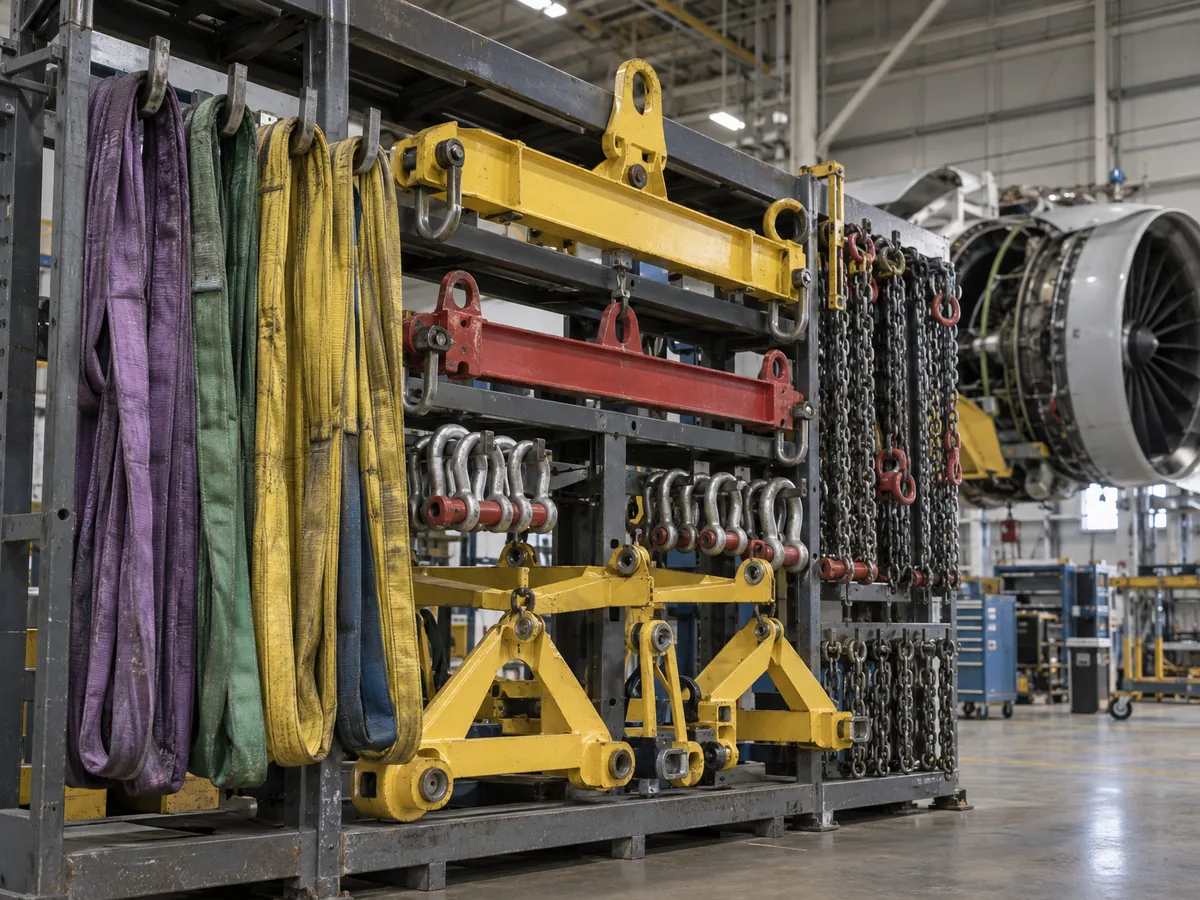
For Rolls-Royce engines the equipment follows the engine program: Rolls-Royce lists the Trent 800 for the Boeing 777 family, states that the Trent 1000 was designed for the Boeing 787 Dreamliner family, and describes the Trent 7000 as created specifically for the Airbus A330neo.
| Item | Manufacturer | Location |
|---|---|---|
| Trent 800 Sling (Transfer Beam), model NGT8T200 | NextGen | Tolleson (AZ), Miami (FL), The Netherlands |
| Trent 1000 Sling | Hydro | Tolleson, AZ |
| Trent 7000 Lift Adapters | Rhinestahl CTS | The Netherlands; Dubai, UAE |
| Trent 7000 Stabilizer Beam | Rhinestahl CTS | The Netherlands; Dubai, UAE |
| Trent 800 FWD Stabilization Mount | Industrial Automation Inc. | Miami, FL |
| Trent 800 AFT Stabilization Adaptor | Hydro | Miami, FL |
| Trent 800 Torque Kit | Boeing | Miami, FL |
| Trent 800 Stand & Adaptor Engine Remote Station | Hyde Group | Miami, FL |
The Trent 800 Sling (Transfer Beam) card lists dual-point attachment (pylon and stand), air-ride trailer certification, an integrated bootstrapping function, full engine transport capability and no component removal for transport. The Trent 1000 Sling listing describes a Hydro engine stand in its text, so confirm the exact configuration when you request a quote. The Trent 7000 lift adapters and the Trent 7000 stabilizer beam are held in two locations each.
What the product cards do not say matters as much. They do not describe the function of the Trent 7000 Stabilizer Beam and Lift Adapters, or of the four Trent 800 stabilization, torque and remote station items, and they do not list a rated capacity for the Trent 1000 and Trent 800 slings. None of the sources we reviewed gives a bare engine weight for the Trent 1000 or Trent 7000. They also do not specify periodic proof-load or inspection intervals for slings, and they contain no published Rolls-Royce guidance on Trent lifting equipment. For all of these, the applicable manufacturer’s instructions govern.
Need a Trent 800 sling? The NextGen Trent 800 Sling (Transfer Beam) is listed in Tolleson (AZ), Miami (FL) and the Netherlands; request a quote on the product page.
An engine sling connects the engine to a hoist so the hoist carries the engine’s weight while the mounting bolts are removed. After removal, the engine is lowered carefully onto a stand and fastened to it.
Sling attaching points are marked on the engine, and their location varies with the size and weight distribution of the engine. FAA guidance is to follow the applicable manufacturer’s instructions and confirm the hoist has sufficient capacity to lift the engine safely. For its HG family, Hydro recommends engine-specific adapter kits per model.
Some can. The AGSE-L012-G01 accommodates the CF6-50, CF6-80C2, CFM56-3, RB211-535 and V2500-A1/A5. The Hydro HG family uses one beam that accepts front and rear adapters to match multiple engine types and mounts.
It depends on the sling. AGSE lists 7,500 lbs (3,402 kg) for the 10C1288 CF34-10E sling, 8,000 lbs (3,629 kg) for the 9C1189 GE90 aft sling and 16,000 lbs (7,257 kg) for the universal AGSE-L012-G01. Hydro rates heavy-lift HG variants up to 9 t.
Not with the Hydro HG family. Hydro states that original engine bolts are not included and must be provided as required by procedure.