Aircraft engines

Aircraft engines
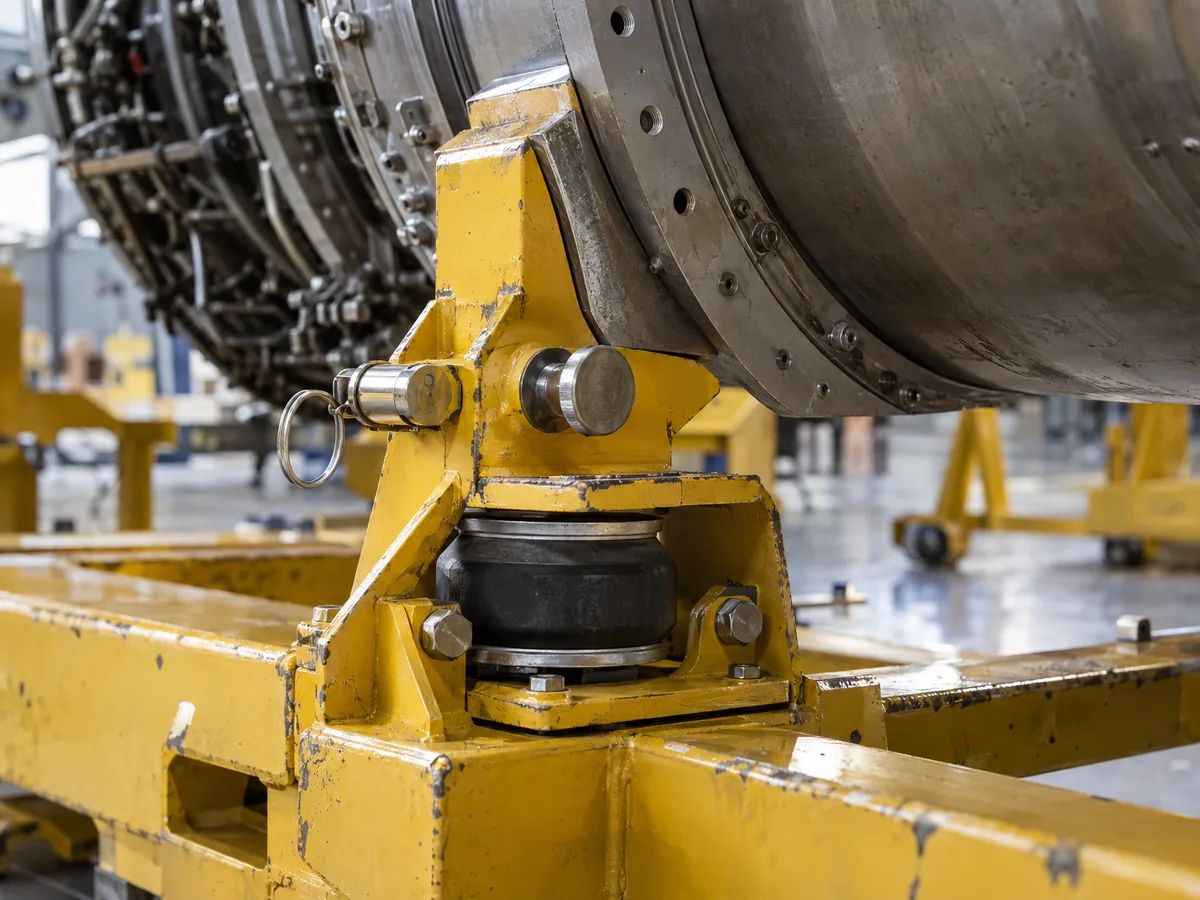
In this guide, an aircraft engine cradle is the frame of an engine stand that the engine sits in, and the base is the frame below it. On several stands in our fleet the two are separate components with their own part numbers, and on the AGSE PW1100 stand the shock mounts sit between cradle and trolley. This guide uses real stands to show how the split works: part numbers, shock isolation, weights and transport modes.
Our product cards do not state a definition of the two terms, so in this guide the cradle means the frame the engine sits in, and the base means the frame below it. The product data makes the split visible. On the AGSE PW1100 stand, shock absorption is listed as 8 mounts between cradle and trolley. On the Dedienne LEAP-1B stand, four single-acting actuators raise and lower the cradle between two vertical settings used for engine work at the wing.
Some cards also list where the stand meets the engine. The Dedienne LEAP-1A stand lists its interface points as the fan frame and the turbine rear frame. The Rolls-Royce Trent 7000 stand lists its bootstrap points as the engine fan case rear and trunnion.
If you are still choosing between stand types, our overview of aircraft engine maintenance stand types covers transport, storage and maintenance configurations.
Several stands in our fleet are catalogued as two parts. The table lists the part numbers exactly as they appear on the product cards.
| Stand | Cradle part number | Base part number |
|---|---|---|
| GE CF34-8E | 2C81052G01 | 2C81051G03 or 2C81051G04 |
| AGSE AM-2689 (V2500-A1/A5) | AM-2689-A1 | AM-2689-B1 |
| AGSE CFM56-5C | AM-2387 | AM-2563 |
| AGSE Trent 500/700 APS | AGSE-E082-G09 | EA AGSE-E079-G02 |
The AGSE CFM56-5C stand is described as a modular design with separate cradle (AM-2387) and base (AM-2563) components. On the Trent 500/700 APS, the cradle and the base are listed under their own part numbers, and the design is stackable for storage.
The CF34-8E card lists two possible base part numbers, 2C81051G03 or 2C81051G04, against one cradle part number, 2C81052G01.
The AGSE CFM56-5A/B stand has a detachable cradle and base and a steel welded frame with rotating tubular arms. Its collapsible cradle design minimizes storage space requirements. The AGSE CFM56-7B stand lists a removable palletized base among its special features, next to bootstrap capability. Stored engines bring their own requirements, covered in our guide to long-term aircraft engine storage.
The AGSE CFM56-5C stand has forklift pockets on both the base and the cradle, plus removable ground handling mounts. The Hydro Trent 1000 stand has multi-directional castors, integrated forklift tubes and a dedicated storage box for trunnions. The GE CF34-8E stand lists bi-directional forklift access. On the AGSE CFM56-7B stand, caster capacity is 5,000 lbs (2,268 kg) each and the maximum towing speed is 3 MPH (5 KM/H).
The AGSE AM-2689 stand accepts both the V2500-A1 and the V2500-A5, using the same base and cradle set. According to the Trent 700 product card, the Trent 500/700 APS takes both engine models on one AGSE base, while the NextGen Trent 700 stand serves the Trent 700 only.
Need a V2500 stand supplied as a cradle and base set? The AGSE V2500-A1/A5 engine stand (PN AM-2689) is available for rent and lease from National Aero Stands.
The product cards describe shock isolation in different ways, and the AGSE PW1100 card states where its mounts sit: between cradle and trolley.
| Stand | Shock isolation as listed |
|---|---|
| AGSE PW1100 | 8 mounts between cradle and trolley |
| Dedienne LEAP-1A | 8 specialized mounts |
| Rolls-Royce Trent 7000 | 18 shock absorber mounts |
| NextGen Trent 800 (NGT8R100) | Shock isolation, Skydrol resistant paint |
| Hydro Trent 1000 Sling | Shock and vibration isolation that removes the need for shock lock-out procedures |
The last row is worth reading twice. The Hydro Trent 1000 Sling card states that its isolation system eliminates the need for shock lock-out procedures. That statement covers this stand only, so check the documentation for any other model.
How the engine reaches the cradle depends on the stand. The AGSE CFM56-7B stand and the GE CF34-8E stand both list bootstrap capability. The AGSE CF34-10E stand supports bootstrap and non-bootstrap variants. On the NextGen Trent 700 stand, engine removal and installation are supported by the bootstrap adaptor and lifting beam kit; the component list also includes collapsible tow-bars, an engine steady mount and castor spacers.
Cradle design also affects access once the engine is in place. The Hydro Trent 1000 Sling stand pairs an open cradle design with foldable trunnions and dedicated storage, which gives unrestricted access to engine components. The Hydro Trent 1000/7000 APS also has an open cradle design and foldable trunnions.

For the two stands below, the cards give the weight of the complete stand, empty and with the engine. Our cards do not list a separate weight for the cradle alone.
| Stand | Empty stand | With engine |
|---|---|---|
| AGSE V2500-A1/5 | 4,850 lbs (2,200 kg) | 10,750 lbs (4,876 kg) |
| AGSE CFM56-7B | 3,684 lbs (1,671 kg) | 8,837 lbs (4,008 kg) |
Transport approval is listed per stand. The GE CF34-8E stand is listed for sea, road and air. The AGSE PW1500 stand lists air, sea, rail and road. The Hydro Trent 1000/7000 APS covers road, sea and air, and is listed as compatible with Beluga, Antonov, B747 and B777 aircraft. The NextGen Trent 800 stand has a truck configuration and an air configuration; the air configuration brings the loaded height down to 121.6 in (3,088 mm) for air freight. For the full move, see how jet engines are transported by road, air and sea.

These are the engine and aircraft pairings stated on the product cards for six of the stands in this guide.
| Stand | Engine | Aircraft as listed |
|---|---|---|
| GE CF34-8E | CF34-8E | Embraer 170/175 |
| AGSE CF34-10E | CF34-10E | Embraer E190/E195 |
| AGSE CFM56-7B | CFM56-7B | Boeing 737 Next Generation: 737-600, -700, -800 and -900 |
| DAE CFM56-5A/B/C | CFM56-5A/B/C | Airbus A320 family |
| AGSE V2500-A1/5 | V2500-A1 and -A5 | V2500 family: Airbus A320ceo family and MD-90 |
| Hydro Trent 1000 | Trent 1000 | Boeing B787-8, B787-10 |
The product cards list these approvals for the stands:
The engine stand is the complete unit. In this guide, the aircraft engine cradle is the frame the engine sits in and the base is the frame below it. On stands such as the AGSE CFM56-5C, the cradle (AM-2387) and the base (AM-2563) are separate components.
On several stands, yes. The GE CF34-8E stand lists cradle part number 2C81052G01 and base part number 2C81051G03 or 2C81051G04. The AGSE Trent 500/700 APS lists cradle AGSE-E082-G09 and base EA AGSE-E079-G02.
Some can. The AGSE AM-2689 set accepts both the V2500-A1 and the V2500-A5. The Trent 500/700 APS takes the Trent 500 and the Trent 700 on one AGSE base. The NextGen Trent 700 stand, by contrast, serves the Trent 700 only.
Our product cards do not list a separate weight for the cradle alone. For the AGSE CFM56-7B they give the complete stand, which weighs 3,684 lbs (1,671 kg) empty and 8,837 lbs (4,008 kg) with the engine.
It depends on the stand. The GE CF34-8E stand is listed for sea, road and air, and the AGSE PW1500 for air, sea, rail and road. The NextGen Trent 800 stand has an air configuration with a loaded height of 121.6 in (3,088 mm).