


LEAP stands for Leading Edge Aviation Propulsion. It is the name of the high-bypass turbofan family built by CFM International – a 50/50 joint venture between GE Aerospace and Safran Aircraft Engines – as the successor to the CFM56. Three variants power today’s main narrow-body jets: the LEAP-1A on the Airbus A320neo, the LEAP-1B on the Boeing 737 MAX and the LEAP-1C on the COMAC C919. Compared with the CFM56 it replaced, the LEAP burns approx. 15 percent less fuel.
| LEAP at a glance | Detail |
|---|---|
| Acronym | Leading Edge Aviation Propulsion |
| Manufacturer | CFM International (50/50 joint venture: GE Aerospace + Safran Aircraft Engines) |
| Program origin | Launched as LEAP-X in July 2008 |
| Predecessor | CFM56 |
| Variants | LEAP-1A (A320neo), LEAP-1B (737 MAX), LEAP-1C (C919) |
| Fuel burn vs CFM56 | Approx. 15 percent lower |
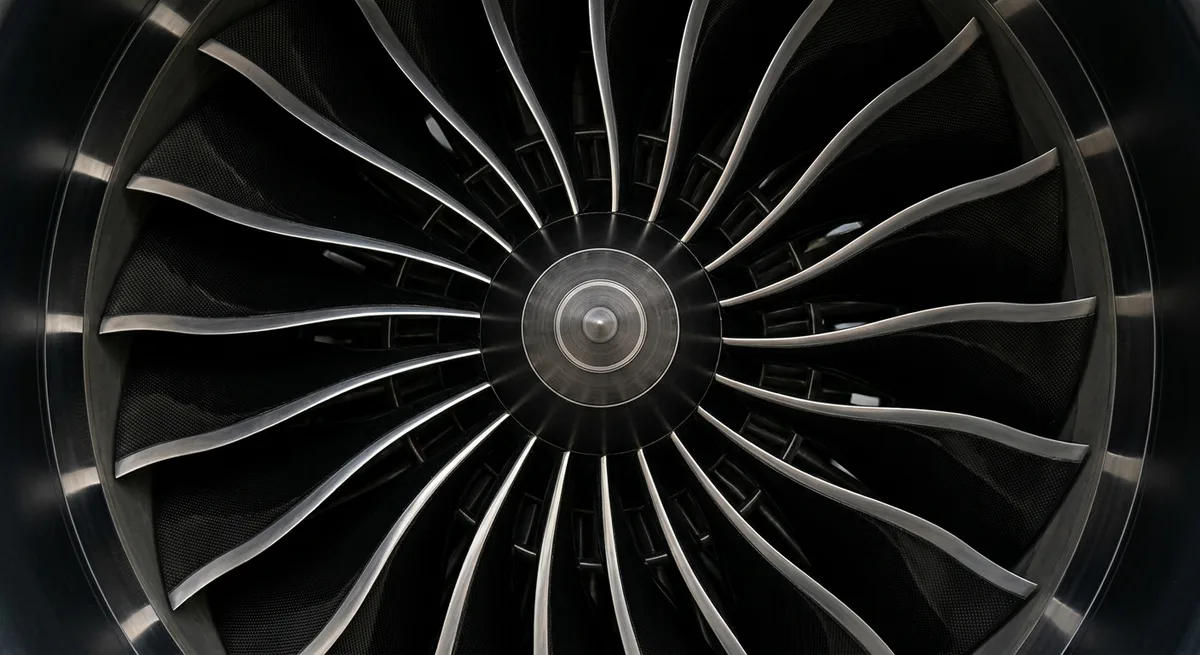
What does the LEAP engine name stand for?
LEAP is an acronym for Leading Edge Aviation Propulsion – a name CFM International chose to signal a generational jump over the CFM56. The program launched in July 2008 under the development name LEAP-X; the “-X” was dropped as the design matured into the commercial product that now powers a large share of the world’s single-aisle fleet.
Behind the name sits a narrow design brief: keep the CFM56’s proven two-shaft layout and rebuild it around materials and manufacturing methods that had only just become viable at production scale. The result burns markedly less fuel and emits less, and takes more effort to maintain than the simpler CFM56. Part of the efficiency comes from running a higher overall pressure ratio than the engine it replaced.
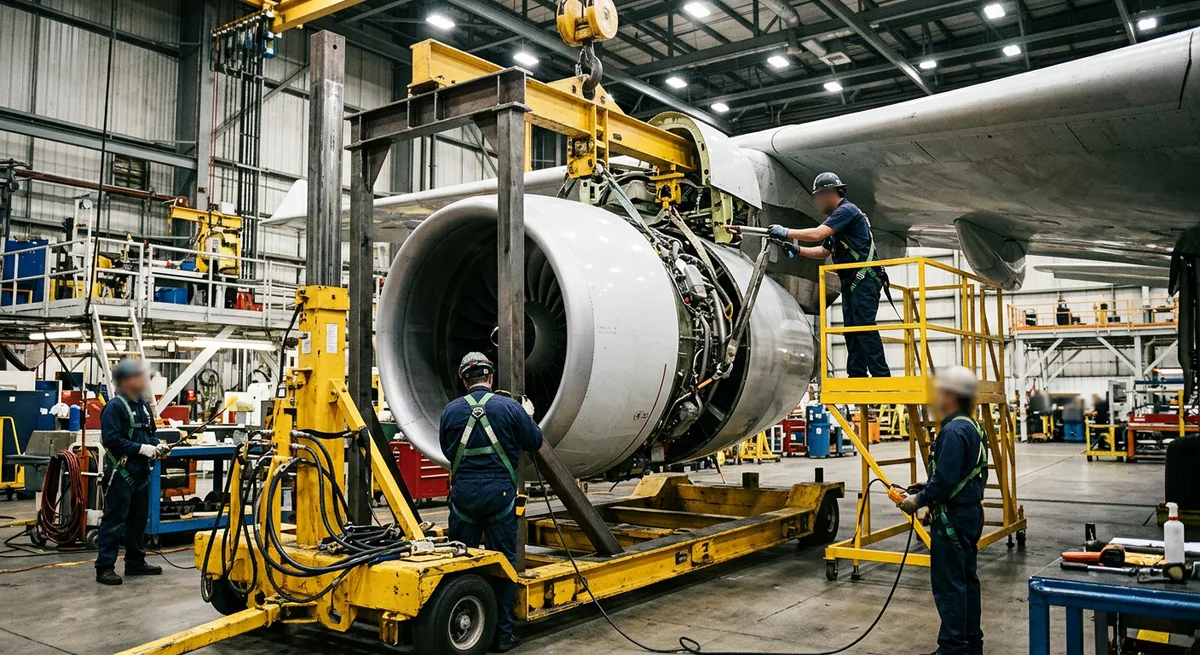
Who makes the LEAP engine?
CFM International manufactures the LEAP family. The workshare follows the pattern set on the CFM56: GE Aerospace is responsible for the core – the high-pressure compressor, combustor and high-pressure turbine – while Safran Aircraft Engines takes the fan and the low-pressure section. Final assembly runs in parallel on both partners’ lines, GE’s in the United States and Safran’s near Paris. The partnership dates to the 1970s, and the CFM56 the two companies built together became the best-selling commercial jet engine family ever – the installed base the LEAP was designed to replace.

LEAP variants and the aircraft they power
Each variant shares a common core but is tailored to one airframe – different fan size, thrust ratings and installation to fit the aircraft’s geometry and mission.
| Variant | Aircraft | Selected by airframer | Entry into service | Fan diameter | Thrust range |
|---|---|---|---|---|---|
| LEAP-1A | Airbus A320neo family (engine option) | December 2010 | 2016 | approx. 78 in | approx. 24,500-35,000 lbf |
| LEAP-1B | Boeing 737 MAX (sole engine) | August 2011 | 2017 | approx. 69 in | approx. 23,000-28,000 lbf |
| LEAP-1C | COMAC C919 (sole Western engine) | December 2009 | 2023 (C919 commercial service) | approx. 78 in | approx. 28,000-30,000 lbf |
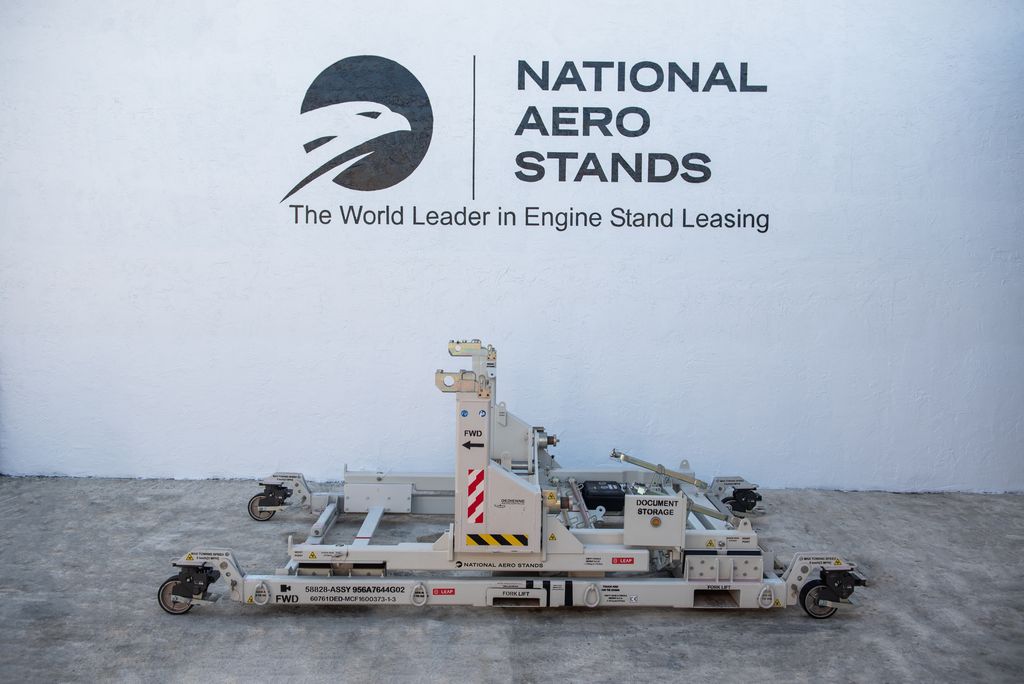
On the A320neo the LEAP-1A competes for every order with Pratt & Whitney‘s PW1100G geared turbofan; on the 737 MAX the LEAP-1B is the only engine offered. The LEAP-1B’s smaller fan follows from the 737’s low wing and the limited clearance between nacelle and ground, and CFM offers it in several thrust ratings (such as the LEAP-1B25, -1B27 and -1B28) so airlines can match power to payload and route profile. When a LEAP-1B comes off wing for shop work or engine shipping, it travels on a dedicated LEAP-1B engine stand built for that variant’s dimensions and mounts. Our overview of aircraft engine stand types explains how transport, storage and shipping configurations differ.
The LEAP-1C stands apart in how it is delivered rather than in what is inside: CFM supplies it as a complete integrated propulsion system, with the nacelle and thrust reverser designed together with the engine and delivered as one package to the C919 assembly line.
Need a LEAP-1A engine stand? National Aero Stands offers transport-rated LEAP-1A engine stands for rent or lease, ready to ship for engine changes, shop visits and AOG events.
How is the LEAP different from the CFM56?
The LEAP keeps the CFM56’s two-shaft layout but changes what the engine is made of. Three changes carry most of the gain, all built on geometries or materials that could not be mass-produced before:
- Additive manufacturing – the LEAP’s 3D-printed fuel nozzles were among the first FAA-certified additively manufactured parts in a commercial jet engine; they are lighter than conventionally built nozzles and resist internal carbon buildup.
- Ceramic matrix composites (CMCs) – lightweight ceramic components in the hot section tolerate higher turbine temperatures than metal alloys, feeding directly into the fuel efficiency gains.
- Woven composite fan – 3D-woven carbon-fiber composite fan blades and case cut weight compared with the CFM56’s titanium fan.
The low-pressure turbine borrows proven wide-body technology: its design is derived from the turbine of GE’s GEnx, adapted to narrow-body thrust levels rather than simply scaled down.
| Parameter | CFM56 | LEAP |
|---|---|---|
| Fuel burn | Baseline | Approx. 15 percent lower |
| Bypass ratio | Approx. 5.1-5.5:1 (CFM56-5B/-7B) | Approx. 9-11:1 depending on variant |
| Fan blades | Titanium | 3D-woven carbon-fiber composite |
| Hot-section materials | Metal alloys | Metal alloys plus ceramic matrix composites |
| Maintenance profile | Simpler, mature, widely supported | More complex; specialized composite repair processes |
The LEAP in service: record and trade-offs
Adoption was fast. CFM International‘s reported milestones trace the ramp-up: the fleet logged its first million flight hours in 2017, the year after entry into service, and passed five million hours in 2019; in 2018 alone CFM delivered 1,118 LEAP engines. The order book has since run into the tens of thousands of engines, making the LEAP the highest-volume narrow-body engine program in production and keeping the family central to commercial aviation for decades to come.
The bill for that growth arrives in the shop. Servicing ceramic matrix composites demands tighter process control than working with traditional alloys, which complicates the repair supply chain. And in 2021 Safran acknowledged that the LEAP-1B is susceptible to premature turbine wear in harsh, sandy environments such as the Middle East and North Africa, prompting ongoing engineering fixes to protect service life. The approx. 15 percent fuel saving therefore buys into a more demanding maintenance ecosystem, and LEAP shop visits, engine swaps and logistics are planned from the start around dedicated tooling and transport equipment. How those engine moves work – air-ride trucks, freighters, route planning – is covered in our aircraft engine transportation guide.
Leading Edge Aviation Propulsion was a claim rather than a description when CFM coined the name in 2008 – a bet by GE and Safran that woven composites, printed fuel nozzles and ceramics were ready for the world’s most-flown aircraft. The delivery record since 2016 has turned the claim into plain fact.
FAQ: the LEAP engine name and family
What does LEAP stand for in aviation?
LEAP stands for Leading Edge Aviation Propulsion. It is the brand name of the turbofan engine family developed by CFM International as the successor to the CFM56, launched as the LEAP-X program in July 2008 and now powering the Airbus A320neo, Boeing 737 MAX and COMAC C919.
Who makes the LEAP engine?
CFM International, a 50/50 joint venture between GE Aerospace and Safran Aircraft Engines. GE is responsible for the core (high-pressure compressor, combustor, high-pressure turbine), Safran for the fan and low-pressure section, and final assembly runs on both partners’ lines. The same partnership previously produced the CFM56.
What is the difference between LEAP-1A, LEAP-1B and LEAP-1C?
The suffix marks the airframe: LEAP-1A powers the Airbus A320neo family, LEAP-1B is the sole engine of the Boeing 737 MAX, and LEAP-1C is the Western engine of the COMAC C919. They share a common core but differ in fan diameter, thrust ratings and installation details.
Is the LEAP engine the same as the CFM56?
No. The LEAP is the CFM56’s successor from the same manufacturer. It keeps a similar two-shaft architecture but adds 3D-printed fuel nozzles, ceramic matrix composites and a woven composite fan, cutting fuel burn by approx. 15 percent while requiring more complex maintenance.
How much fuel does the LEAP engine save?
CFM International quotes approx. 15 percent lower fuel consumption than the previous-generation CFM56, with correspondingly lower CO2 emissions and reduced noise. Actual savings vary with route profile, thrust rating and operating environment, but the roughly 15 percent figure is the accepted fleet-level benchmark.
What was LEAP-X?
LEAP-X was the original development name of the program when CFM International launched it in July 2008. As the design matured into a commercial product, the “-X” was dropped and the engine family entered the market simply as LEAP, in its -1A, -1B and -1C variants.